
DocuPipe vs Extend on 72 hard, real-world documents

Nitai Dean
Updated Jul 16th, 2026 · 11 min read
Table of Contents
- Why the difference between the two tests?
- The documents
- How we scored
- How to configure each system
- Results
- The error profile matters as much as the score
- A closer look: a US oil and gas check stub
- A closer look: a brokerage statement
- What we are not claiming
- Three things Extend cannot do
- Reproduce it
- What to ask any benchmark
- FAQ
- Summary
DocuPipe vs Extend on 72 hard, real-world documents
DocuPipe and Extend are both intelligent document processing (IDP) tools. You give each one a document, a schema (meaning the list of fields you want to extract), and it reads the document and returns those fields as structured JSON. Both are AI-first: they use models to interpret a document rather than the hand-built, per-template rules that older extraction software relied on, so they generalize across layouts they were never set up for in advance. We run DocuPipe, and Extend is a direct competitor.
So: how do you tell two tools like these apart? On clean, single-page forms, most of them reach accuracies in the high nineties, so the headline metrics rarely separate them. The gap opens on the tougher documents, the ones you see in the real world. Things like invoice line items, multipage statements, payslips in non-Latin languages, and scanned or handwritten forms.
To test DocuPipe against Extend on those harder cases, we built a public benchmark of 72 hard documents with traceable public sources and ran both systems on it. The set is deliberately messy: arrays and tables, twelve languages including right-to-left, CJK, and Devanagari scripts, rotated scans, handwriting, and ten file types. We also ran both on Extend's own benchmark, RealDoc-Bench, so the comparison was not only on data we chose. The result? DocuPipe came out clearly ahead on the hard set, and even eked out a victory on Extend's RealDoc-Bench.
The whole benchmark is public: the 72 documents, the hand-verified labels, the schema for each one, raw output from every complete configuration, the scorer, and a link to every document's original source. You can rerun it yourself from the public benchmark repository on GitHub, or explore the accuracy benchmarks in the interactive DocuBench explorer. It shows the same public results, with filters for language, file type, document length, and challenge type.
Results at a glance
Our hard public benchmark: DocuPipe 97.03% vs Extend 80.22%.
Extend's RealDoc-Bench QA: DocuPipe 95.31% vs Extend 95.15%.
Extend does well on flat field lookup, but DocuPipe's lead opens up once the documents get challenging: arrays, tables, multiple pages, multiple languages, rotated scans, and mixed file types. The full 72-document benchmark, including every label and every complete configuration's raw output, is public on GitHub.
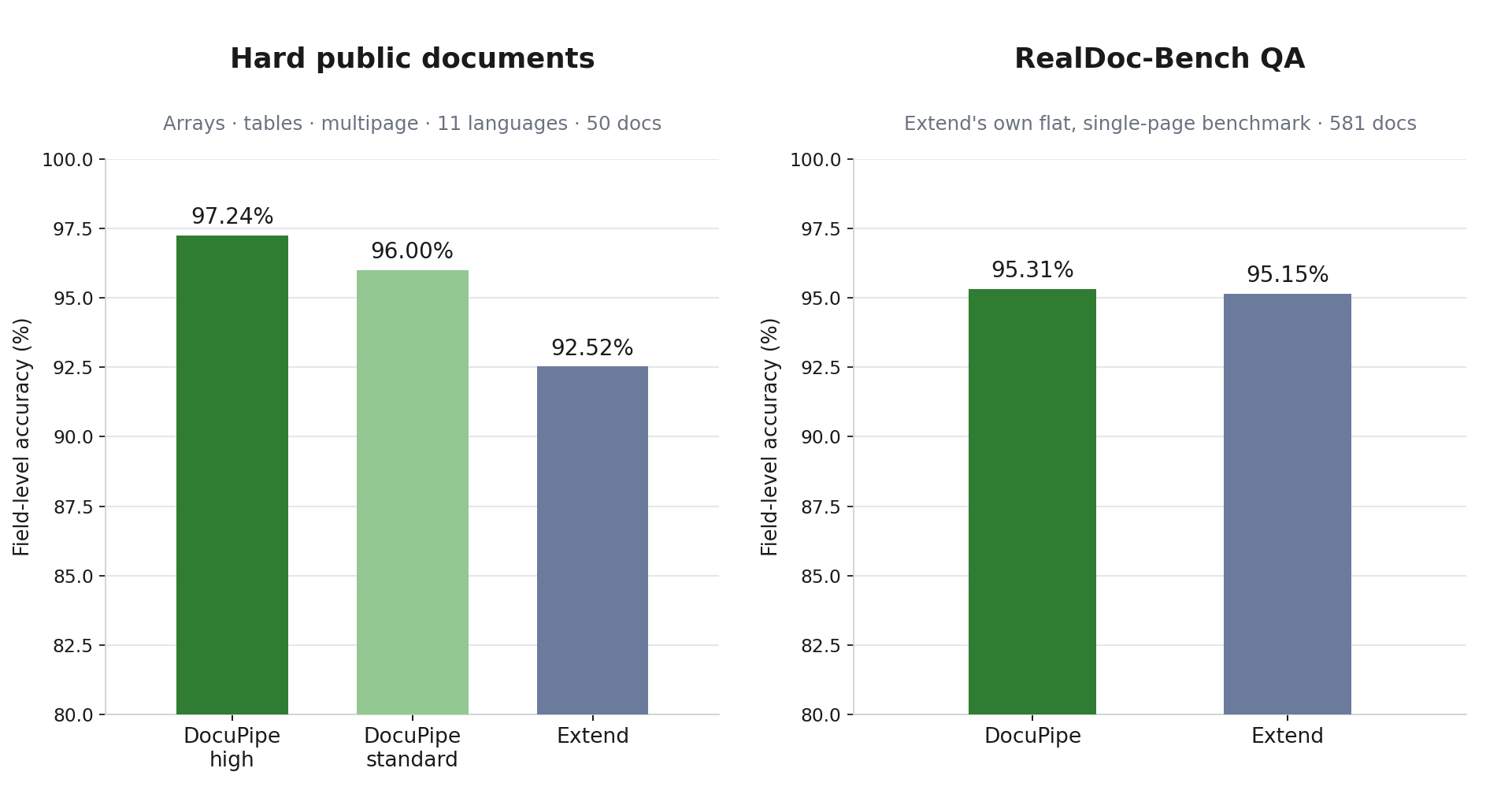 Two bar charts. Left: the hard public benchmark, where DocuPipe high (97.03%) and standard (96.16%) both lead Extend (80.22%). Right: Extend's own RealDoc-Bench QA, where DocuPipe (95.31%) and Extend (95.15%) finish within a fifth of a point of each other
Why the difference between the two tests?
A single accuracy number is not the full story, and doesn't reveal a crucial element: what kind of documents got tested. A benchmark of clean single-page forms only shows whether a system can find a few fields on a tidy page. That is the easy part of document extraction. The hard half is pulling 58 activity rows out of an 18-page brokerage statement, reading a right-to-left Hebrew payslip, and holding a table together across a page break.
This is why the RealDoc-Bench result matters as setup rather than as the headline. Extend published RealDoc-Bench, an open benchmark for real-world document parsing and question answering. It is a useful dataset, spanning hundreds of documents across finance, healthcare, mortgage, and supply chain, but it has limitations. Each document is only a single page, and the schemas are flat and primitive-only, with no nested objects and no arrays. That is a narrow slice of the real-world extraction problem, and only reflects one part of what users actually care about.
It is also Extend's own dataset, which cuts in their favor, not ours. They selected the documents and published the answer key, and we cannot rule out that their models were trained on these exact samples. So that narrow win is not the headline. It came on the other side's home field, on the kind of flat document where the real gap does not show. It is the result we wanted to establish before moving to the documents that do separate the two systems.
In real-world data and use cases, here is what shows up in practice:
- invoice line items
- bank and card transactions
- brokerage holdings and activity rows
- insurance coverage limits
- lab-result panels
- rent schedules
- bills of lading
- purchase-order rows
- utility charge tables
A tool that reads an invoice header but drops the line items is not ready for accounts payable. A tool that reads a brokerage statement but hallucinates extra activity rows is not ready for lending. So we built a second benchmark out of those cases.
The documents
The 72-document set is built to be hard on structure, volume, language, and capture quality. Every document has a traceable public source, and every label was authored for this benchmark and then checked by eye against the source.
| Documents | 72 |
| Languages | 12 (English, Hebrew, Japanese, Chinese, Arabic, French, German, Portuguese, Dutch, Italian, Spanish, Hindi/Devanagari) |
| File types | 10 (PDF, JPEG, PNG, TIFF, XLSX, CSV, XML, TXT, DOCX, HTML) |
| Pages | 1 to 40 per document, 448 pages total |
| Structure | most documents carry at least one array, multipage, nested, or table feature |
Take this Japanese invoice. Thirty line items run down the page in vertical CJK, with product codes, unit prices, and a total that has to reconcile. A flat field-lookup benchmark doesn't address the complexity of this type of extraction.
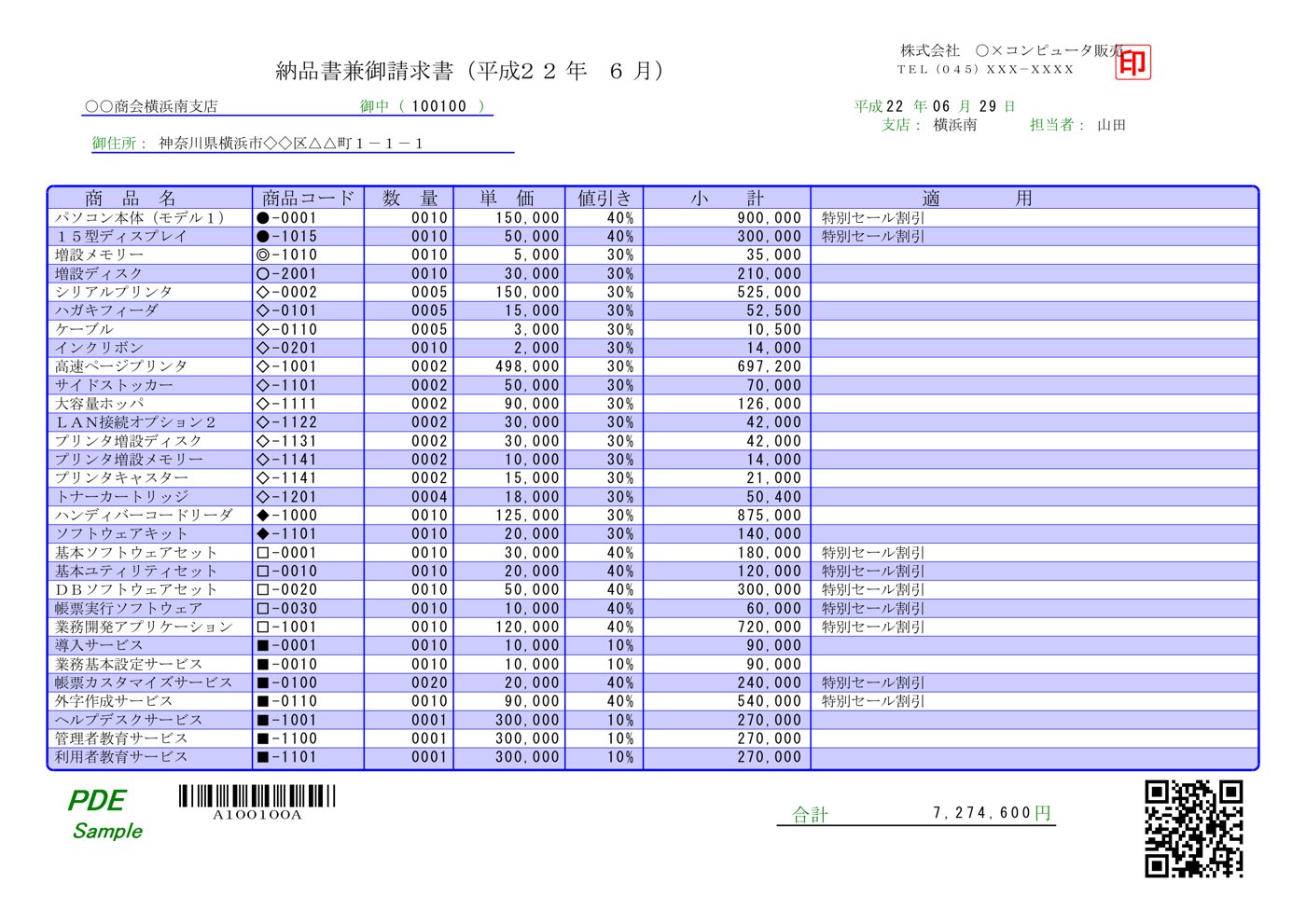 A Japanese tax invoice with thirty line items in a dense vertical table, product codes, quantities, unit prices, and a reconciling total
The rest of the set is similar: a right-to-left Arabic tax invoice with a charge array and VAT, a 32-row freight statement, dense historical dictionaries and directories, a German balance sheet that has to reconcile to the cent, an engineering drawing with part numbers in small print, handwritten forms, and a receipt shot at an angle on a wooden table. Sources include government filings, sample bills, public templates, vendor sample documents, historical publications, public financial reports, and sample structured files.
The latest 22 documents deliberately stress output completeness as well as recognition. They include scanned dictionaries, telephone directories, government registers, an auction catalog, and a drug price list with hundreds or thousands of repeated records. A system can read the first page perfectly and still fail the task if it silently stops after a fraction of the requested rows. That is why the expanded set separates systems more sharply than the original 50-document run.
Where DocuPipe, Extend, and our label disagreed, we treated it as a reason to audit ourselves first. If Extend returned an answer that was defensible under the schema, we fixed the schema or the label rather than scoring Extend down for our own ambiguity. That keeps the benchmark from collapsing into "our system versus our labels."
How we scored
Both engines ran the same way. We applied the same JSON schema to the same document through each system, then scored the returned JSON against the hand-verified label.
Accuracy is field-level. We count the leaf fields the system got right and divide by the total number of leaf fields in the label. If a label has 40 fields and the system gets 4 wrong, that is 90%. A field that is blank in both the label and the output is skipped rather than counted as a free match, so empty fields do not pad the score.
The two benchmarks used different scorers on purpose, because they are different tasks. For RealDoc-Bench we used the benchmark's structured gold answers with a deterministic equality scorer adapted to its answer format, after manually confirming that whitespace and punctuation normalization created no false matches. For the 72-document set we used DocuPipe's regular eval scorer, which is built for schema-shaped extraction.
Arrays get one extra step. A naive array scorer compares the first labeled row to the first returned row, the second to the second, and so on. That punishes a system for returning the right data in a different order, which is the wrong thing to penalize. Two systems can return the same 30 transactions in a different sequence and both be correct.
So our document scorer treats each array as a set of records and matches returned rows to labeled rows by best pairing before scoring their fields. Order does not count against either system. What counts is whether the rows, and the fields inside them, are right. Both engines are scored this exact same way, against the exact same labels.
How to configure each system
DocuPipe has a single setting that affects extraction: standard effort, or high effort. That's it. You pick standard by default, and for complex use cases, you pick high (if the results justify it).
In contrast to DocuPipe's simplicity, Extend exposes an entire configuration grid. You choose a parse engine, then an extract engine, then decide which add-on surcharges to stack on top, including an agentic OCR mode and a review agent, and there are marketed bundles like Performance Mode and a maxed-out everything-on mode. The combinations multiply quickly, and it is genuinely hard to know which one to run for a given document.
It also does not behave the way the names suggest. When we swept the grid, Extend's marketed Performance Mode and its everything-on mode both scored several points lower than a plainer configuration that their pricing tiers do not even surface. Turning on more add-ons made accuracy worse, not better.
So to keep the comparison fair, we did not run Extend on a default. We tried its settings, found the configuration that scored highest on average, and used that. We ran each platform at its best, and then compared the results.
Results
On the 72-document set, field-level accuracy was:
| System | Accuracy |
|---|---|
| DocuPipe high effort | 97.03% |
| DocuPipe standard effort | 96.16% |
| Extend | 80.22% |
DocuPipe runs at two effort levels. Standard is the default; high spends more compute per document. Both beat Extend here, so the lead does not depend on running the expensive tier.
Aggregate numbers flatten the story. On clean, simple forms both products often reach 100%. The 16.8-point gap opens on the long, multilingual, and structurally dense documents, where incomplete arrays and abandoned extractions create large misses.
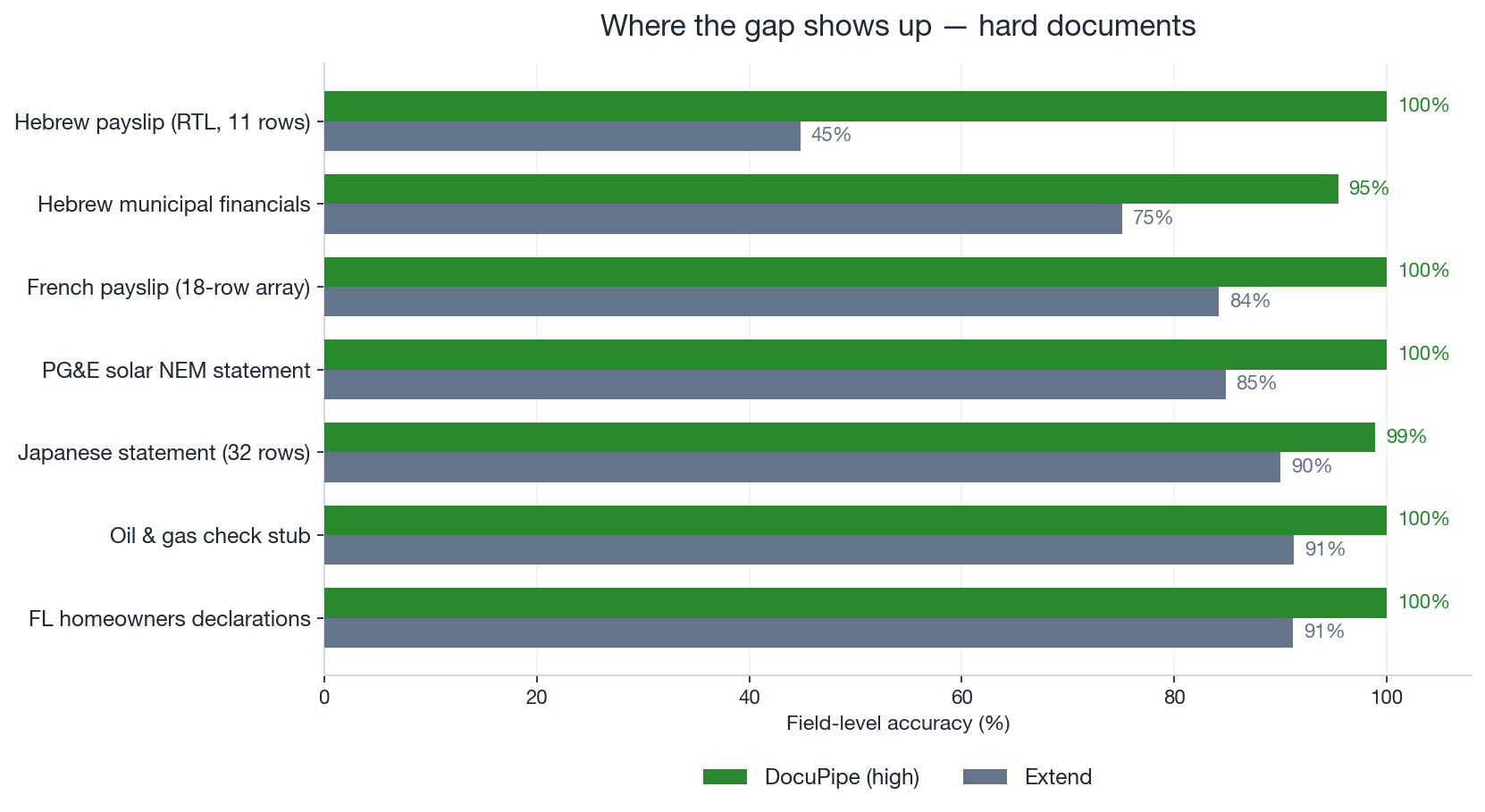 Horizontal bar chart comparing DocuPipe and Extend on seven hard documents. DocuPipe sits at or near 100% on all of them, while Extend trails: 45% on a Hebrew payslip, 63% on Hebrew municipal financials, 81% on a French payslip, 85% on a PG&E solar statement, 90% on a Japanese statement, 91% on an oil-and-gas check stub, and 91% on a Florida homeowners declaration
The Hebrew payslip is the clearest case. It is one page, right-to-left, with five payment rows and six deduction rows. Its amounts are printed in the Israeli convention where the last two digits are agorot (cents) and there is no decimal point: base pay prints as
1095000, meaning 10,950.00 shekels.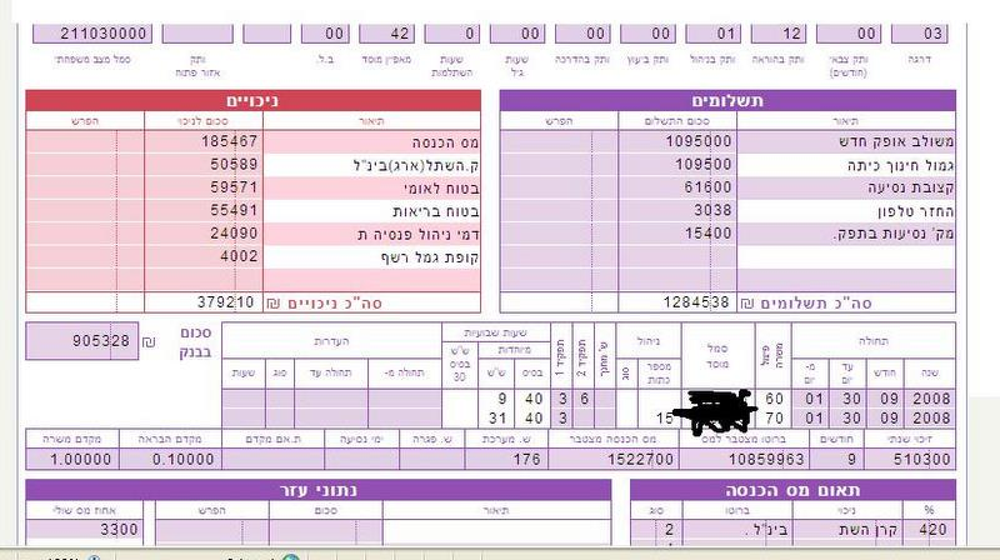 A real Hebrew payslip used in the benchmark, with right-to-left payment and deduction tables
On this single Hebrew payslip, DocuPipe scored 100% and Extend scored 44.8%. Both systems got the structure right: every payment and deduction row, every Hebrew label, in the correct order. The difference was the numbers. DocuPipe read the local convention correctly, turning
1095000 into 10,950.00 shekels; Extend returned the digits literally as 1,095,000. Every amount on the page is off by the same factor of a hundred. A representative sample:| Field | DocuPipe | Extend |
|---|---|---|
| Base pay | 10,950.00 | 1,095,000 |
| Education increment | 1,095.00 | 109,500 |
| Travel allowance | 616.00 | 61,600 |
| Income tax | 1,854.67 | 185,467 |
| National insurance | 595.71 | 59,571 |
| Health insurance | 554.91 | 55,491 |
| Total payments | 12,845.38 | 1,284,538 |
| Net to bank | 9,053.28 | 905,328 |
DocuPipe matches the hand-verified label on every row; Extend made the identical error on all eleven line items and every total.
Both engines saw the exact same schema, and neither was told about the convention. But there is only one correct reading: the payment rows minus the deduction rows equal the printed net pay. DocuPipe inferred that from the document, and Extend did not. On a payslip, that is the difference between ₪10,950 and ₪1,095,000 landing in a payroll run. These are exactly the kind of real-world "gotchas" that separate the good extractors from the great ones. The ability to just get it right.
The same pattern repeats across the hard cases.
Multilingual and right-to-left. Hebrew, Japanese, Chinese, Arabic, and the European languages all stress reading order, field naming, and local number formats. Extend's French payslip dropped to 81% and its Hebrew municipal financials to 63%, while DocuPipe stayed at or near 100%.
Array-heavy. Line items, transactions, holdings, coverage limits, charges, and lab results all require returning complete, correctly-ordered records rather than isolated values. This is where over-inclusion and dropped rows corrupt a result.
Multipage and cross-page. Statements, contracts, and financial reports force the extractor to carry context across page boundaries instead of treating each page on its own.
Beyond PDF. Spreadsheet, CSV, XML, TXT, DOCX, HTML, TIFF, and PNG inputs, because real pipelines are rarely PDF-only.
The error profile matters as much as the score
The scores are only half the story; how each system misses is the other half, and the pattern held on both benchmarks. DocuPipe tends to be conservative. When it misses, it is usually because a character or token was read or split incorrectly. Extend tends to be looser. Its misses skew toward over-inclusion, where extra nearby text gets appended to a value, and hallucination, where a value appears even though the field on the document is empty.
That difference matters in production. A conservative miss is easy to catch on review. An invented value looks exactly like a real one and flows straight downstream into an ERP, an underwriting model, or a ledger. The next two documents show both in practice: a check stub where Extend fabricates a value in a blank cell and pulls another from the wrong column, and a brokerage statement where it appends an annotation onto the field above it.
A closer look: a US oil and gas check stub
Aggregate percentages are easy to wave away, so here is a single English document where you can read the right answer off the page yourself.
This is the line-item table from a Samson Energy oil and gas revenue check stub. Two property rows, each with its own unit price, volumes, taxes, and a column of itemized deductions.
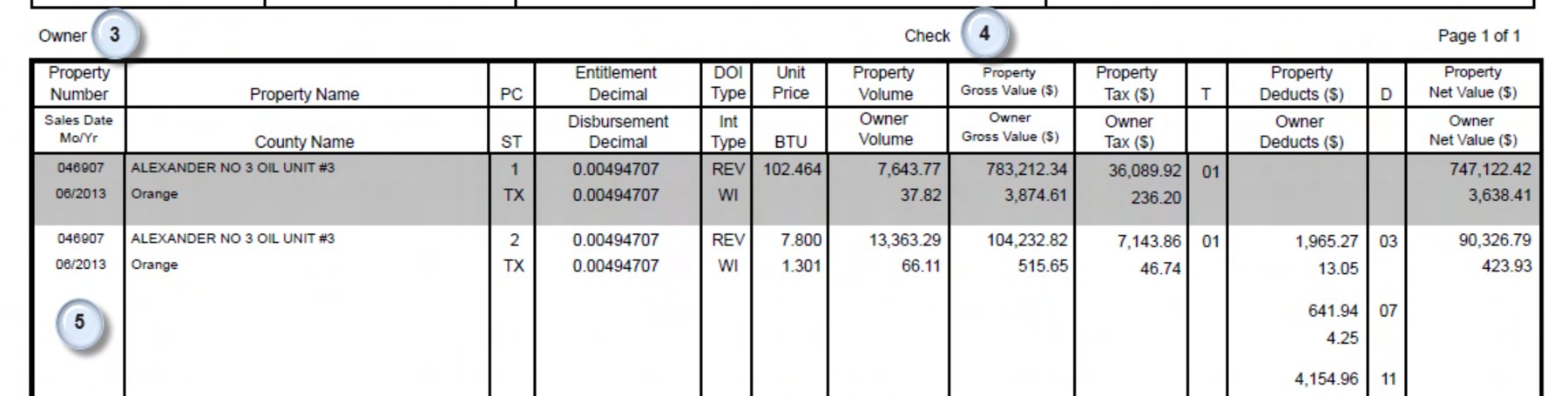 The line-item table from an oil and gas check stub, showing two property rows with separate Unit Price and BTU columns and a multi-line Owner Deducts column
Read the gas row, product code 2. The document prints a Unit Price of 7.800 and a BTU of 1.301 in two separate columns. Its owner deductions are three itemized lines that add up to 44.98. The oil row above it has an empty owner-deductions cell. Here is what each system returned:
| Field | What the document shows | DocuPipe | Extend |
|---|---|---|---|
| Gas row, unit price | 7.800 | 7.80 ✓ | 1.301 ✗ (copied the BTU column) |
| Gas row, owner deductions | 13.05 + 4.25 + 27.68 = 44.98 | 44.98 ✓ | 13.05 ✗ (took only the first of three lines) |
| Oil row, owner deductions | (blank on the document) | (left blank) ✓ | 0 ✗ (invented a value) |
Three different failure modes on one small table. Extend pulled a number from the wrong column, returned an incomplete sum from a multi-line cell, and filled a blank field with a fabricated
0. On a revenue statement, each of those is a wrong dollar figure that looks legitimate downstream.A closer look: a brokerage statement
The over-inclusion failure shows up on this Fidelity brokerage statement, the same 18-page, 58-row document from the top of the post. In the Other Activity block, both rows are the same security, "REFCO INC COM". The lines printed beneath each name are per-transaction annotation: an escrow rate, a merger reference, and a payout ID. The transaction type is captured separately, in its own column, as "Merger".
 The Other Activity block of a Fidelity brokerage statement, showing two REFCO INC COM merger lines, each with three lines of escrow-payment annotation printed beneath the security name
| Security name (ground truth) | DocuPipe | Extend |
|---|---|---|
| REFCO INC COM | REFCO INC COM ✓ | REFCO INC COM ESCROW PAYMENT AT $0.148525 PER SHARE MER PAYOUT #REORCM0050704800000 ✗ |
| REFCO INC COM | REFCO INC COM ✓ | REFCO INC COM ESCROW PAYMENT AT $0.148525 PER SHARE MER FROM 758ESC982 REORUM0050704800002 ✗ |
This isn't how Extend reads the field elsewhere, which makes it an inconsistency as much as an over-inclusion. On the same statement it returns the clean security name on every other holding, matching the label exactly, even when the name itself wraps onto a second line:
 The Trades Pending Settlement block of the same Fidelity statement, where Extend returns each security name exactly, including SPDR SER TR BARCLAYS CAP HIGH YIELD BD ETF whose name wraps onto a second line
| Security name (ground truth) | DocuPipe | Extend |
|---|---|---|
| SPDR SER TR BARCLAYS CAP HIGH YIELD BD ETF | SPDR SER TR BARCLAYS CAP HIGH YIELD BD ETF ✓ | SPDR SER TR BARCLAYS CAP HIGH YIELD BD ETF ✓ |
| SPDR SER TR BARCLAYS CAP HIGH YIELD BD ETF | SPDR SER TR BARCLAYS CAP HIGH YIELD BD ETF ✓ | SPDR SER TR BARCLAYS CAP HIGH YIELD BD ETF ✓ |
| SABRA HEALTH CARE REIT INC COM USD0.01 | SABRA HEALTH CARE REIT INC COM USD0.01 ✓ | SABRA HEALTH CARE REIT INC COM USD0.01 ✓ |
| SPDR SER TR BARCLAYS CAP HIGH YIELD BD ETF | SPDR SER TR BARCLAYS CAP HIGH YIELD BD ETF ✓ | SPDR SER TR BARCLAYS CAP HIGH YIELD BD ETF ✓ |
The difference is what sits beneath the name. A name that wraps to a second line, like this one, both engines join correctly. But on exactly four rows an annotation is printed under the name instead, and only there does Extend absorb it: the two REFCO lines, an MGM bond (it appends "TRADE EXECUTED BY MLCO"), and an ENSTAR transfer (a reference number). Everywhere else, Extend returns just the name.
These kinds of inconsistencies are painful. The two REFCO rows are the same security, yet Extend gives them different names, because what it appended is per-transaction detail, an escrow rate and a payout ID. Group holdings by name downstream, and one REFCO position becomes two, the kind of boundary error a flat single-line benchmark never surfaces.
What we are not claiming
No extraction system wins on every document, and this benchmark does not show one that does. On clean, single-language, structured documents, both products frequently hit 100%. They both score perfectly on 20 documents. The 16.8-point gap comes from the hard cases, not from a broad advantage on easy ones.
DocuPipe is not perfect on the hard cases either. On an engineering drawing with part numbers printed in a worn stencil font, bad OCR can pull either product down, and that is an OCR-fidelity problem, not a structure problem.
Extraction is also not perfectly repeatable. The underlying models are non-deterministic, so a given document's score can move between runs. The repository preserves the exact raw outputs used for the published scores.
Three things Extend cannot do
Three of Extend's limits are about what it can take in and represent, not about accuracy:
- It does not accept JSON as an input file. A
.jsonupload is rejected, where DocuPipe extracts from JSON directly. - Its schema cannot represent an array of plain strings. Every array item has to be an object, so a simple list, like a set of diagnosis names or the bullet points in an HTML document, has to be wrapped in objects rather than returned as a flat list.
- Its schema fields cannot carry examples. DocuPipe lets each field include example values to steer extraction; Extend rejects the
exampleskeyword, so we were forced to fold every field's examples into its description text to give Extend the same guidance.
We designed around all three so that all 72 documents run on both engines and the comparison stays apples to apples, and none of them counted against Extend's score. They are still real constraints if your inputs are JSON, your fields are plain string arrays, or your schema leans on per-field examples.
Reproduce it
The 72-document benchmark is public, on GitHub. The repository contains the source documents, the hand-verified labels, the schema applied to each document, every complete configuration's raw extraction output, the scorer, and a full provenance record for every document. The scorer reproduces the aggregate numbers in this post from the committed results. Source documents retain their original licenses or publication basis; benchmark-authored labels, schemas, and metadata are licensed separately.
You don't need to clone the repo to dig in: the interactive DocuBench explorer presents the same results document by document, filterable by language, file type, length, and challenge type.
What to ask any benchmark
When you evaluate a document extraction tool, do not stop at the headline accuracy. Ask what the benchmark is made of:
- Single page or multipage?
- Arrays and repeated records, or just isolated fields?
- Tables that span pages?
- Non-English documents?
- Rotated scans and phone photos?
- File types beyond PDF?
- Are blank fields tested for fabrication?
- Are labels hand-verified, and are disagreements audited or just assumed correct?
Those questions decide the outcome. The closer a benchmark gets to the documents that carry real business data, the more the difference between two tools like these shows.
FAQ
No. The first benchmark, RealDoc-Bench, is Extend's, on Extend's public documents and Extend's answer key, and we still came out slightly ahead. The second benchmark is ours, but every document in it is public, and every label was audited so that defensible Extend answers fixed our schema instead of scoring Extend down. Both sets are inspectable.
Because those are private customer files. Sending them to a competitor would mean shipping real customer data out, and it would not be a benchmark anyone else could inspect. Building the hard set from public documents keeps it both private-safe and reproducible.
They are two effort levels on the same DocuPipe extraction. Standard is the default. High effort spends more compute per document and is the lever for genuinely hard inputs. On the hard benchmark, standard already beat Extend, and high effort widened the gap.
No, and no extraction system does. On clean, simple forms both products frequently hit 100%. The claim is narrower: when the task shifts from flat field lookup to preserving structure across hard, multilingual, multipage documents, DocuPipe's lead is clear and consistent.
Summary
Two public head-to-head benchmarks, same conclusion.
On Extend's RealDoc-Bench QA dataset, DocuPipe scored 95.31% and Extend scored 95.15%. A narrow win, by 6 fields out of 3,753.
On our 72-document public benchmark of hard, structured, multilingual documents, DocuPipe scored 97.03% and Extend 80.22%.
Flat field lookup is a solved-enough problem that many systems look good on it. The moment a document has structure worth preserving is where extraction quality starts to matter, and where the gap shows.
Recommended Articles

Related Documents