
Total Cost of Processing (TCP) in Highly Regulated Industries

Uri Merhav
Updated Mar 27th, 2026 · 14 min read
Table of Contents
Total Cost of Processing (TCP) in Highly Regulated Industries
Document AI vendors love ROI calculators. Input your document volume, see projected savings, sign the contract. These calculators share a common flaw: they measure the wrong costs.
Basic calculators compare AI processing costs to a simplistic estimate of manual processing. They assume documents flow smoothly, errors are rare, and compliance is automatic. They ignore the costs that actually dominate regulated document processing: rework from errors, audit preparation, regulatory penalties, and the operational overhead of maintaining compliance.
What You Need to Know
The problem: Basic ROI calculators only count labor savings. They miss error correction (2-5x the included costs), audit prep ($20K-$450K per audit), regulatory penalties, and compliance overhead.
What most miss: Regulated industries have costs that AP automation never encounters - HIPAA compliance, SOX requirements, FOIA responses, examiner reviews.
The real math: For a 50K application/year benefits center, manual TCP is $4.95M. AI-assisted TCP is $1.37M. That's 72% savings - most of it from costs basic calculators ignore.
Bottom line: If your ROI calculator doesn't include audit prep, error remediation, and regulatory risk, you're measuring the wrong things.
For the broader context on enterprise document AI infrastructure, see the Enterprise Document AI Infrastructure hub article.
Moving Beyond the Basic Accounts Payable ROI Calculator
The typical document AI ROI pitch focuses on accounts payable. Invoice processing is easy to understand, easy to measure, and produces impressive numbers. This focus obscures more valuable applications and understates true costs.
Why AP Calculators Mislead
AP-focused ROI has several problems:
Commodity pricing pressure:
Invoice processing is well-understood and highly competitive. Margins are thin. Any vendor can claim AP automation. Differentiation is difficult.
Simple documents:
Most invoices follow standard formats. They have predictable fields in predictable locations. Accuracy rates are high. The hard problems are elsewhere.
Limited compliance burden:
While AP has some audit requirements, it lacks the regulatory intensity of healthcare, government, or financial services. Compliance costs are understated.
Ignored complexity:
Organizations considering document AI rarely need help only with invoices. They have contracts, applications, medical records, legal documents, and regulatory filings. AP calculators ignore these entirely.
What Basic Calculators Miss
Standard ROI calculations typically include:
- AI processing cost per document
- Estimated manual processing time
- Assumed hourly labor rate
- Simple multiplication to show savings
What they exclude:
- Error correction and rework time
- Audit preparation and response
- Regulatory compliance overhead
- Risk costs from errors
- Integration and maintenance
- Training and change management
- Exception handling
These excluded costs often exceed the included costs by factors of 2-5x in regulated industries.
The Regulated Industry Difference
Regulated industries face costs that AP automation never encounters:
Healthcare:
- HIPAA compliance requirements
- Medical record accuracy obligations
- Patient safety implications of errors
- Audit response requirements
- Breach notification and remediation
Financial services:
- SOX compliance for financial records
- FINRA requirements for communications
- SEC filing accuracy
- Examination preparation
- Error correction disclosures
Government:
- Records retention requirements
- FOIA response obligations
- Benefits accuracy mandates
- Inspector General reviews
- Congressional oversight response
These costs dwarf the simple labor savings from faster document processing.
The True Cost of Manual Redaction and Audit Failures
Manual document processing in regulated industries involves more than data entry. It includes review, verification, redaction, audit preparation, and error correction. Each activity has quantifiable costs.
Labor Cost Baselines
Accurate cost analysis requires accurate labor rates. Bureau of Labor Statistics data provides reliable benchmarks:
Entry-level processors:
- Paralegals and legal assistants: $19-$30/hour (10th-50th percentile)
- Data entry and information clerks: $15-$22/hour
- Administrative assistants: $18-$27/hour
Experienced processors:
- Senior paralegals: $30-$48/hour (50th-90th percentile)
- Compliance analysts: $35-$55/hour
- Medical records specialists: $25-$40/hour
Specialized reviewers:
- Contract reviewers: $75-$125/hour
- Medical reviewers (clinical): $100-$200/hour
- Legal reviewers (attorney): $150-$400/hour
Overhead multipliers:
Labor costs should include benefits, facilities, equipment, and management overhead. Typical multipliers range from 1.3x to 1.8x base salary.
Document Processing Time Analysis
Manual processing time varies by document type and required actions:
Simple data entry:
- Standard forms: 2-5 minutes per page
- Invoices: 3-8 minutes per document
- Structured applications: 5-15 minutes per application
Review and verification:
- Quality review: 1-3 minutes per page
- Dual verification: 2x processing time
- Exception review: 10-30 minutes per exception
Redaction:
- Manual identification of sensitive content: 5-15 minutes per page
- Redaction application: 2-5 minutes per page
- Verification of redaction: 2-5 minutes per page
- Total: 10-25 minutes per page requiring redaction
Complex document processing:
- Contract review: 15-45 minutes per page
- Medical record abstraction: 10-30 minutes per page
- Legal document analysis: 20-60 minutes per page
Audit Preparation Costs
Regulated industries face regular audits. Preparation costs include:
Document retrieval:
- Locating requested documents
- Verifying completeness
- Organizing for review
- Creating indices and summaries
Response preparation:
- Drafting responses to findings
- Gathering supporting evidence
- Management review and approval
- Legal review of responses
Audit support:
- Staff time during auditor site visits
- Document provision and explanation
- Follow-up question response
- Finding remediation
Typical audit costs for document-intensive reviews:
| Audit Type | Preparation | Support | Response | Total |
|---|---|---|---|---|
| Internal audit | $10K-$30K | $5K-$15K | $5K-$20K | $20K-$65K |
| External audit | $25K-$75K | $15K-$40K | $10K-$50K | $50K-$165K |
| Regulatory exam | $50K-$200K | $25K-$100K | $25K-$150K | $100K-$450K |
Organizations with poor document management face higher costs at every stage.
Error Correction Costs
Errors in regulated documents have cascading costs:
Detection costs:
- Sampling and quality reviews
- Audit findings requiring correction
- Customer/patient complaints
- Downstream system failures
Correction costs:
- Identifying affected documents
- Researching correct values
- Updating records
- Verification of corrections
- Documentation of corrections
Consequential costs:
- Regulatory penalties
- Customer remediation
- Legal liability
- Reputation damage
Error cost examples:
| Error Type | Detection | Correction | Consequence | Total |
|---|---|---|---|---|
| Data entry error | $50 | $100 | $0-$500 | $150-$650 |
| Compliance violation | $500 | $2,000 | $5K-$50K | $7.5K-$52.5K |
| Material misstatement | $2,000 | $10,000 | $50K-$500K | $62K-$512K |
See the real cost breakdown for your documents.
A Total Cost of Processing (TCP) Framework
This TCP framework provides comprehensive cost analysis for document processing decisions. It incorporates all cost categories and uses industry data sources.
Cost Category Framework
TCP analysis considers five cost categories:
1. Direct processing costs:
- Labor for document handling
- Technology licensing
- Infrastructure costs
- Vendor service fees
2. Quality assurance costs:
- Review and verification labor
- Sampling programs
- Quality metric tracking
- Correction activities
3. Compliance costs:
- Audit preparation and response
- Regulatory filing
- Policy maintenance
- Training and certification
4. Risk costs:
- Expected penalty exposure
- Error remediation reserves
- Insurance premiums
- Legal defense reserves
5. Overhead costs:
- Management and supervision
- Facilities and equipment
- IT support
- Change management
Manual Processing TCP Calculation
For a baseline manual processing cost, consider a government benefits processing center:
Volume: 50,000 applications per year
Direct processing:
- 20 pages average per application
- 8 minutes per page for data entry
- $25/hour fully loaded labor cost
- Subtotal: $3.33 per page, $66.67 per application
- Annual: $3.33M
Quality assurance:
- 10% dual verification: $333K
- 2% exception review: $67K
- Correction activities: $100K
- Subtotal: $500K
Compliance:
- Annual audit preparation: $75K
- Regulatory response: $50K
- Training: $40K
- Subtotal: $165K
Risk:
- Error remediation (2% rate, $200 average): $200K
- Penalty exposure reserve: $50K
- Subtotal: $250K
Overhead:
- Management (15% of direct): $500K
- Facilities and equipment: $200K
- Subtotal: $700K
Total manual TCP: $4.95M annually
Per application: $99
Per page: $4.95
AI-Assisted Processing TCP Calculation
Same volume with document AI:
Direct processing:
- AI processing: $0.50 per page
- Human review (15% of volume): $1.00 per page reviewed
- Subtotal: $0.65 per page average
- Annual: $650K
Quality assurance:
- Reduced verification (confidence-based): $150K
- Exception review: $50K
- AI-specific monitoring: $40K
- Subtotal: $240K
Compliance:
- Audit preparation (reduced with audit trails): $40K
- Regulatory response: $30K
- AI governance: $30K
- Subtotal: $100K
Risk:
- Error remediation (0.5% rate): $50K
- AI-specific risk reserve: $30K
- Subtotal: $80K
Overhead:
- Reduced management: $200K
- Technology operations: $100K
- Subtotal: $300K
Total AI-assisted TCP: $1.37M annually
Per application: $27.40
Per page: $1.37
Savings: $3.58M annually (72%)
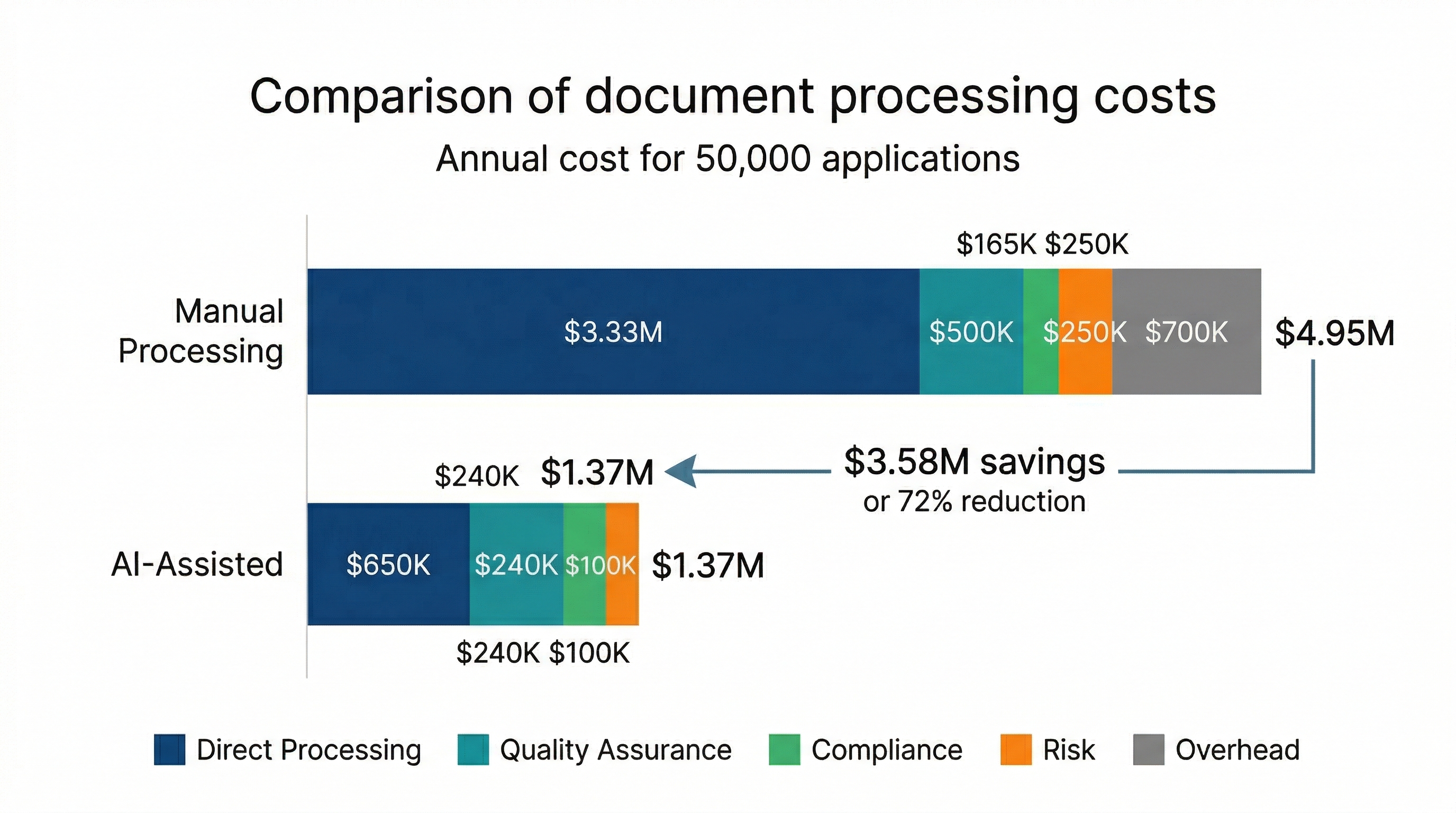 Direct comparison of document processing costs showing Manual Processing at $4.95M versus AI-Assisted at $1.37M with $3.58M savings
Sensitivity Analysis
TCP calculations depend on assumptions. Sensitivity analysis tests how results change:
Labor rate sensitivity:
- Lower rates ($20/hour): Savings reduced to 65%
- Higher rates ($35/hour): Savings increased to 78%
- Labor rates primarily affect manual baseline
Accuracy sensitivity:
- Lower AI accuracy (90%): More human review, savings 58%
- Higher AI accuracy (98%): Less review, savings 79%
- Accuracy affects both processing and risk costs
Volume sensitivity:
- Lower volume (25K): Fixed costs matter more, savings 62%
- Higher volume (100K): Scale benefits, savings 76%
- Volume affects amortization of fixed costs
Compliance intensity sensitivity:
- Lower compliance burden: Smaller absolute savings
- Higher compliance burden: Larger absolute savings
- Regulated industries see greatest benefit
Break-Even Analysis
When does AI investment pay off?
Implementation costs:
- Integration and setup: $50K-$200K
- Training and change management: $20K-$50K
- Process redesign: $30K-$100K
- Total: $100K-$350K
Monthly savings:
- From TCP calculation: ~$298K monthly
Break-even:
- Simple payback: 1-2 months
- With risk adjustment: 2-4 months
- Conservative estimate: under 6 months
For most regulated industry document processing, AI investment has rapid payback.
TCO Comparison Framework
Compare alternatives using consistent methodology:
| Cost Category | Manual | Basic AI | Enterprise AI |
|---|---|---|---|
| Direct processing | High | Low | Low |
| Quality assurance | High | Medium | Low |
| Compliance | High | Medium | Low |
| Risk | High | Medium | Low |
| Overhead | Medium | Low | Medium |
| Implementation | None | Low | High |
| Total Year 1 | Highest | Medium | Medium-High |
| Total Year 2+ | Highest | Medium | Lowest |
Basic AI reduces direct processing costs but may not address compliance and risk. Enterprise AI with proper controls addresses all cost categories.
Implementation Recommendations
TCP analysis should guide implementation decisions:
Prioritization by TCP Impact
Not all document types have equal TCP. Prioritize:
High TCP documents:
- Regulated filings with penalty exposure
- High-volume processing with labor intensity
- Complex documents requiring specialized review
- Documents with significant error consequences
Lower TCP documents:
- Simple, low-volume document types
- Documents with minimal compliance burden
- Cases where manual processing is fast
- Documents where AI accuracy is uncertain
Phased Implementation
Reduce risk through phased deployment:
Phase 1: High-confidence, high-TCP document types
- Validate accuracy and savings
- Build operational experience
- Refine processes
Phase 2: Medium-complexity document types
- Expand volume
- Address edge cases
- Optimize thresholds
Phase 3: Complex and edge cases
- Handle difficult documents
- Achieve full scope
- Continuous improvement
Ongoing TCP Monitoring
TCP is not static. Monitor and adjust:
- Track actual costs against projections
- Identify cost drivers and variances
- Adjust processing based on observed TCP
- Report savings and value delivery
Key Takeaways
- Basic ROI calculators miss 2-5x the actual costs - error correction, audit prep, and regulatory penalties often exceed simple labor savings
- Regulated industries face unique cost drivers - HIPAA, SOX, FOIA, and examiner reviews create overhead that AP automation never encounters
- TCP analysis changes the math dramatically - $4.95M manual vs $1.37M AI-assisted in the example, with most savings from "hidden" costs
- Payback is fast - implementation costs of $100K-$350K pay back in 1-6 months at typical volumes
- Prioritize high-TCP documents first - regulated filings with penalty exposure, not simple invoices
Calculate your actual document processing costs.
Basic calculators compare AI processing cost to simple manual processing time, ignoring error correction (2-5x the included costs in regulated industries), audit preparation ($20K-$450K per audit), regulatory penalties, compliance overhead, quality assurance, risk reserves, and management overhead. These excluded costs often exceed the costs that calculators include.
Bureau of Labor Statistics data shows: entry-level processors (paralegals, data entry) at $15-30/hour, experienced processors (compliance analysts, medical records specialists) at $25-55/hour, and specialized reviewers (contract, medical, legal) at $75-400/hour. Overhead multipliers of 1.3x-1.8x should be applied for fully loaded costs.
For the government benefits processing example (50,000 applications/year), manual TCP is $4.95M annually while AI-assisted TCP is $1.37M. That's 72% savings of $3.58M. With implementation costs of $100K-$350K, simple payback is 1-2 months. Even with risk adjustment, most deployments break even within 6 months.
Recommended Articles
Related Documents
Related documents:
Related documents:
Invoice
CT-e
Non-Disclosure Agreement
Medical Record
BAS
NDA
Explanation of Benefits
Request for Information
Health Insurance Claim
Vision Insurance Claim
Health Insurance Application
Auto Insurance Claim
General Liability Application
Title Insurance Policy
Title Search Report
+