
ISO 27001, SOC 2, and Compliance for AI Pipelines

Uri Merhav
Updated Mar 30th, 2026 · 14 min read
Table of Contents
ISO 27001, SOC 2, and Compliance for AI Pipelines
The security questionnaire lands on your desk: 847 questions. Your document AI vendor needs to answer them before procurement will approve the contract. Three weeks later, the responses come back. Half are vague. A quarter reference "enterprise-grade security" without specifics. The SOC 2 report covers their marketing website, not their AI pipeline.
Most document AI vendors fail enterprise security evaluations. Not because they lack certifications, but because their certifications don't cover what matters. A vendor may hold SOC 2 Type II while falling short of your specific requirements. They may claim HIPAA compliance without the architectural controls healthcare organizations demand. They may position toward FedRAMP without the years of investment required for actual authorization.
This article examines why AI wrapper architectures fail vendor security assessments, what current certifications actually require, and which AI governance controls enterprise teams should evaluate.
For the broader context on enterprise document AI infrastructure, see the Enterprise Document AI Infrastructure hub article.
Why AI Wrappers Fail Vendor Security Assessments
The typical document AI vendor is an API wrapper around foundation model APIs. Customer documents flow through the wrapper to an underlying LLM (Claude, GPT, Gemini), then structured results return. This architecture creates compliance gaps that security assessments expose.
Shared Infrastructure Concerns
Multi-tenant architectures aggregate customers on shared infrastructure. Security assessors ask:
- Which other customers share processing resources?
- How is data isolated between tenants?
- Can one customer's processing affect another's availability?
- Who at the vendor can access customer data?
Wrapper vendors typically rely on logical isolation (separate API keys, database rows) rather than physical isolation (dedicated instances, separate networks). For many enterprise security teams, logical isolation is insufficient.
Third-Party Dependency Chains
When a wrapper vendor processes documents through OpenAI or Anthropic APIs, the customer's data traverses multiple organizations:
- Customer to wrapper vendor
- Wrapper vendor to foundation model provider
- Foundation model provider's internal infrastructure
- Back through the same chain
Each hop introduces risk. Each organization must be assessed. Enterprise security teams must evaluate not just the vendor but every third party the vendor depends upon.
Questions emerge:
- Does the foundation model provider retain customer data?
- Are documents used for model training?
- What jurisdictions does data traverse?
- Who can access data at each organization?
Many wrapper vendors cannot answer these questions definitively because they do not control the underlying infrastructure.
Audit Trail Gaps
Enterprise compliance requires complete audit trails. Every action on customer data must be logged, retained, and available for examination.
Wrapper architectures often have audit gaps:
- Foundation model APIs may not provide detailed logs
- Logs from different systems may not correlate
- Retention periods may not meet regulatory requirements
- Log access may require vendor cooperation
When auditors ask "show me every access to document X," wrapper vendors may be unable to provide complete answers.
Model Governance Absence
Traditional software has deterministic behavior. Given the same input, it produces the same output. Compliance frameworks assume this predictability.
AI systems are different:
- Models may produce different outputs for identical inputs
- Model updates change behavior without code changes
- Performance can degrade over time without visible cause
- Bias can emerge or shift as data distributions change
Wrapper vendors typically have no control over model governance. When the foundation model provider updates their model, all customers receive the change simultaneously. There is no version pinning, no controlled rollout, no ability to validate before deployment.
FedRAMP, HIPAA, and the New Expectations
Compliance certification requirements vary by industry and data type. Understanding what each certification actually requires helps evaluate vendor claims.
SOC 2 Type II: The Baseline
SOC 2 Type II is the minimum credible certification for enterprise SaaS. It validates that:
- Security controls exist and are documented
- Controls were operating effectively over a review period (typically 12 months)
- An independent auditor verified control operation
SOC 2 covers five trust service criteria:
- Security (required): Protection against unauthorized access
- Availability: System availability meets commitments
- Processing Integrity: Processing is complete and accurate
- Confidentiality: Confidential information is protected
- Privacy: Personal information is handled appropriately
For document AI, relevant SOC 2 controls include:
- Access controls limiting who can view customer data
- Encryption for data at rest and in transit
- Logging of all access and processing events
- Incident response procedures
- Vendor management for third-party dependencies
SOC 2 is necessary but not sufficient for many enterprises. It validates that controls exist but does not specify which controls are required.
ISO 27001: International Framework
ISO 27001 provides an international information security management system framework. Certification validates:
- A documented ISMS covering the organization's information assets
- Risk assessment and treatment processes
- Management commitment to security
- Continuous improvement mechanisms
For global enterprises, ISO 27001 is often required alongside SOC 2. It provides a framework that maps to regional requirements and demonstrates mature security practices.
FedRAMP: Federal Government Requirements
FedRAMP authorization is required for cloud services used by federal agencies. The requirements are substantially more rigorous than SOC 2:
Control baseline:
- FedRAMP Moderate requires 323 security controls
- FedRAMP High requires 410 controls
- Controls are based on NIST SP 800-53
Assessment process:
- Third-party assessment organization (3PAO) evaluation
- Complete documentation of system architecture
- Penetration testing and vulnerability scanning
- Continuous monitoring after authorization
Operational requirements:
- Monthly vulnerability scanning
- Annual assessments
- Incident reporting within specific timeframes
- POA&M (Plan of Action and Milestones) management
FedRAMP authorization takes 12-24 months and significant investment. Vendors claiming to be "FedRAMP ready" or "pursuing FedRAMP" are years away from actual authorization.
HIPAA: Healthcare Requirements
HIPAA compliance for document AI involves multiple components:
Business Associate Agreement:
- Contract between covered entity and vendor
- Specifies permitted uses of PHI
- Defines security obligations
- Establishes breach notification requirements
Technical safeguards:
- Access controls limiting PHI access
- Audit controls recording PHI access
- Integrity controls preventing unauthorized alteration
- Transmission security for PHI in transit
Administrative safeguards:
- Security awareness training
- Workforce clearance procedures
- Incident response procedures
- Contingency planning
HIPAA does not have a certification process. Compliance is self-attested and validated through audits, often during breach investigations. Vendors claiming "HIPAA compliance" should provide BAA capability and documentation of technical safeguards.
Emerging AI Governance Requirements
Beyond traditional compliance frameworks, new AI-specific requirements are emerging:
Model transparency:
- Documentation of training data sources
- Known limitations and failure modes
- Performance metrics by data segment
- Bias testing results
Drift monitoring:
- Continuous performance measurement
- Alerts when accuracy degrades
- Retraining triggers and procedures
- Version control for models
Output governance:
- Confidence scoring for predictions
- Human review thresholds
- Override and correction procedures
- Audit trails for AI decisions
Risk management:
- AI-specific risk assessments
- Mitigation strategies for identified risks
- Incident response for AI failures
- Regular review and updates
These requirements draw from standards like the NIST AI Risk Management Framework and anticipate requirements that certification bodies will formalize.
SOC 2 AI Addendum: What to Look For
Traditional SOC 2 controls assume deterministic software. AI systems require additional controls that address probabilistic behavior, model governance, and output verification. Use the following checklist when evaluating document AI vendors for enterprise deployment.
Logging and Auditability
Standard SOC 2 requires logging of access and changes. For AI systems, logging must extend to:
Model invocation logging:
- Every call to AI models is logged
- Input documents are identified (not stored in logs)
- Model versions are recorded
- Processing parameters are captured
Output logging:
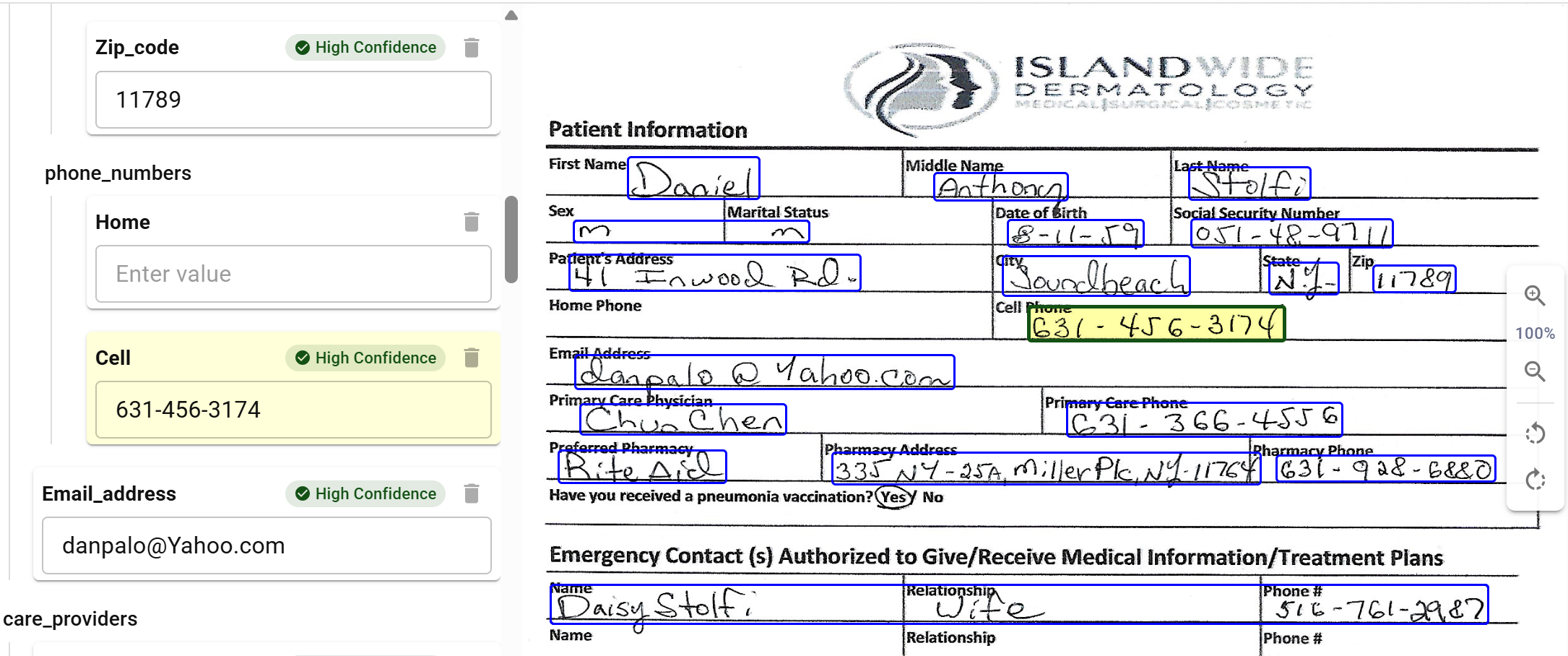 Visual review showing confidence indicators and provenance
- Extraction results are logged with timestamps
- Confidence scores are recorded
- Provenance information is preserved
- Schema versions are noted
Decision logging:
- Routing decisions (human review vs. automatic processing)
- Threshold evaluations
- Override actions with justification
- Correction events with before/after states
Retention requirements:
- Logs retained for compliance periods (typically 7 years for financial)
- Immutable storage prevents tampering
- Access to historical logs for audits
- Correlation between related log entries
Drift Monitoring
Model performance changes over time. Drift monitoring detects degradation before it causes business impact:
Accuracy monitoring:
- Sample-based verification against ground truth
- Confidence score distributions tracked
- Correction rates by document type
- Trend analysis for early warning
Data distribution monitoring:
- Input document characteristics tracked
- New document types identified
- Population shifts detected
- Alerts when distributions diverge
Alerting and response:
- Thresholds for performance degradation
- Escalation procedures when alerts trigger
- Investigation and remediation processes
- Communication to affected customers
Documentation:
- Monitoring methodology documented
- Alert thresholds justified
- Response procedures specified
- Historical performance records maintained
Tenant Isolation
Multi-tenant AI systems require stronger isolation than traditional SaaS:
Processing isolation:
- Customer documents processed in isolated contexts
- No cross-tenant data leakage through model state
- Separate processing queues per customer
- Resource limits prevent interference
Data isolation:
- Customer data in separate storage partitions
- Encryption with customer-specific keys
- Access controls enforcing tenant boundaries
- No aggregation across tenant data
Model isolation:
- Per-tenant model fine-tuning isolated
- Custom schemas separated by tenant
- Training data from one tenant never used for another
- Model artifacts tagged with tenant ownership
Telemetry isolation:
- Logs and metrics separated by tenant
- No cross-tenant patterns visible
- Dashboards scoped to single tenant
- Alerting isolated per tenant
Bias and Fairness Controls
AI systems can exhibit bias that creates compliance risk:
Bias testing:
- Regular testing across demographic segments
- Document type performance comparison
- Language and regional variation analysis
- Results documented and reviewed
Mitigation procedures:
- Identified biases trigger remediation
- Temporary controls while fixes develop
- Customer notification when bias affects them
- Long-term fixes tracked to completion
Fairness documentation:
- Testing methodology documented
- Results retained for audit
- Known limitations disclosed
- Customer communication records maintained
Continuous monitoring:
- Ongoing testing, not just initial validation
- New bias patterns detected early
- Customer feedback incorporated
- Regular review of fairness metrics
Incident Response
AI incidents differ from traditional security incidents:
AI-specific incident types:
- Mass misextraction events
- Model failures affecting accuracy
- Bias emergence in production
- Unexpected model behavior
Response procedures:
- Detection mechanisms for AI incidents
- Escalation paths defined
- Customer notification thresholds
- Remediation and prevention measures
Communication:
- Incident severity classification
- Customer notification templates
- Regulatory notification requirements
- Post-incident reporting
Learning and improvement:
- Root cause analysis for all incidents
- Prevention measures implemented
- Similar risks proactively addressed
- Incident database for pattern analysis
Implementation Guidance
Achieving comprehensive compliance requires systematic effort across the organization.
Assessment Process
Begin with gap assessment:
- Inventory current certifications and controls
- Map requirements from target frameworks
- Identify gaps between current state and requirements
- Prioritize gaps by risk and effort
- Develop remediation roadmap
Control Implementation
Implement controls systematically:
- Design controls to address identified gaps
- Document control objectives and procedures
- Implement technical and administrative controls
- Test control effectiveness
- Collect evidence for auditors
Continuous Compliance
Compliance is not a point-in-time achievement:
- Monitor control effectiveness continuously
- Update controls as requirements evolve
- Conduct regular internal assessments
- Prepare for external audits
- Learn from audit findings
Vendor Evaluation
When evaluating document AI vendors, verify:
- Current certifications with scope details
- Third-party dependencies and their certifications
- Audit trail capabilities
- Model governance practices
- AI-specific controls beyond standard frameworks
Request documentation, not just claims. Review actual SOC 2 reports. Verify FedRAMP authorization in the marketplace. Confirm BAA terms before signing.
Conclusion
Compliance for document AI extends beyond traditional frameworks. AI systems introduce risks that standard controls do not address. Model governance, logging, and access controls are essential for enterprise deployment.
Organizations evaluating document AI must look beyond checkbox certifications. A SOC 2 report validates security controls exist but does not validate they address AI-specific risks. FedRAMP authorization matters for federal use but does not cover AI governance. HIPAA BAAs enable healthcare use but do not ensure extraction accuracy.
DocuPipe's security program addresses foundational controls. Logging captures processing events. Tenant isolation through workspaces prevents cross-customer data access. Infrastructure monitoring tracks system health.
For enterprises deploying document AI in regulated environments, comprehensive compliance is not optional. It is the foundation that enables confident adoption.
Wrapper architectures process customer documents through shared infrastructure and third-party foundation model APIs, creating audit gaps. They often cannot demonstrate complete data isolation, may lack control over model governance, and cannot provide detailed audit trails across the dependency chain. Enterprise security teams require answers that wrapper vendors structurally cannot provide.
DocuPipe maintains ISO 27001 certification and HIPAA Business Associate Agreement capability. Specific certification scope details are available upon request during vendor evaluation.
Beyond standard SOC 2 controls, evaluate AI vendors for: processing event logging, tenant isolation for customer data, audit trails linking extractions to source documents, and incident response procedures for AI-specific issues like mass misextraction. These controls address risks that traditional compliance frameworks do not fully cover.
Recommended Articles
Related Documents