
6 min read
DocuPipe vs Reducto: Which is best for your team? [2026]

Published March 22, 2026

Reducto is code-only infrastructure: engineers orchestrate Extract, Split, and Edit endpoints themselves. DocuPipe is a complete pipeline: schema dashboard for ops teams, built-in human review, webhooks that fire automatically. Both platforms extract structured JSON from documents - the difference is who they're built for.
TL;DR
Reducto is code-only infrastructure: engineers orchestrate endpoints, manage schemas in code, build their own review UI. DocuPipe is built for teams where ops and engineering collaborate: schema dashboard, built-in human review, webhooks that just work. Same JSON output, different philosophies.
Table of Contents
- DocuPipe vs Reducto at a glance
- Two platforms, different philosophies
- Schema management: code-only vs dashboard UI
- Source traceability: DocuPipe's source highlighting vs coordinates
- Built for engineers vs built for teams
- Human-in-the-loop: built-in vs build-your-own
- When to choose Reducto vs DocuPipe
- A note on third-party validation
- Which should you choose?
- FAQ
DocuPipe vs Reducto at a glance
| DocuPipe | Reducto | |
|---|---|---|
| Built for | Teams (ops + engineering collaborate) | Engineers (full code control) |
| Schema management | Dashboard UI, AI-suggested fields, ops-friendly | Code-only, devs manage in codebase |
| Document routing | Auto-classify and route to correct schema | You write the routing logic |
| Source highlighting | Built-in source highlighting UI | Bounding box coords (build your own UI) |
| Human review | Built-in verification UI | Build your own |
| Compliance | HIPAA, ISO 27001 | SOC 2, HIPAA |
| Deployment | Cloud or on-premise available | Cloud, VPC, on-prem options |
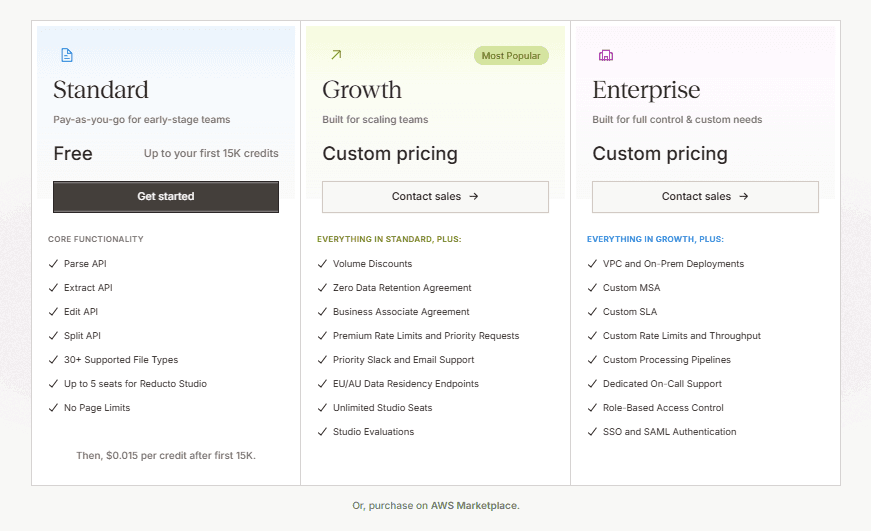
| Pricing | $99/mo (predictable) | $350/mo for 15K pages + RAG overhead |
Ready to see the difference?
Get up to 20,000 free credits with an eligible work email. No credit card required.
Two platforms, different philosophies
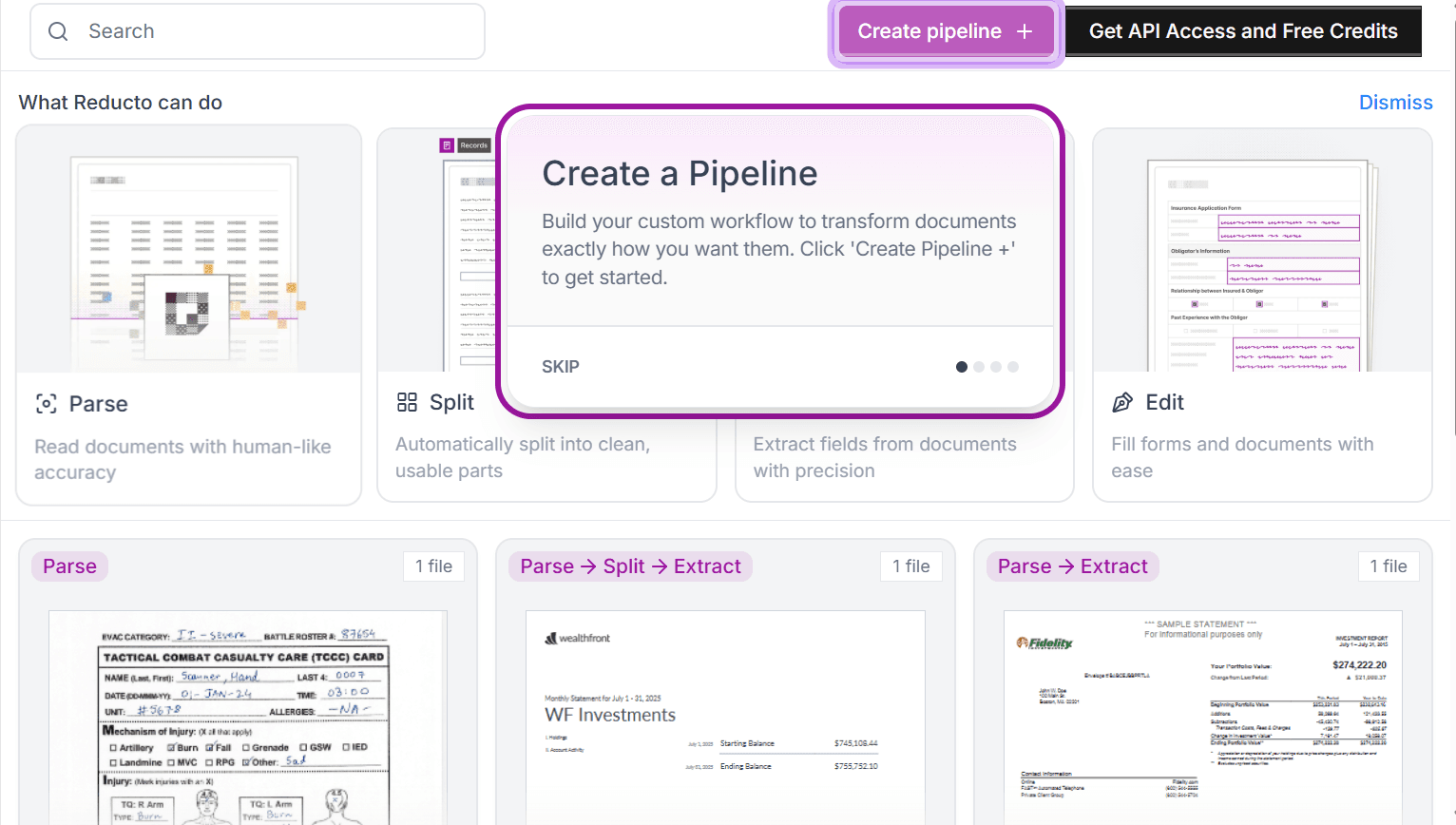
Reducto is code-only infrastructure for engineering teams who want full control. Their Extract, Split, and Edit endpoints work, but you're assembling the pipeline yourself.
The difference isn't capability - it's operating model. Reducto is code-only infrastructure built for engineering teams who want full control. Schemas live in your codebase. You orchestrate the endpoints. You build the review UI. DocuPipe is a complete pipeline built for teams where ops and engineering collaborate. Schemas live in a dashboard. Verification is built in. Webhooks fire automatically.
Same JSON output, different philosophies. The question is whether your team wants to assemble extraction infrastructure or use a pipeline that works out of the box.
Schema management: code-only vs dashboard UI
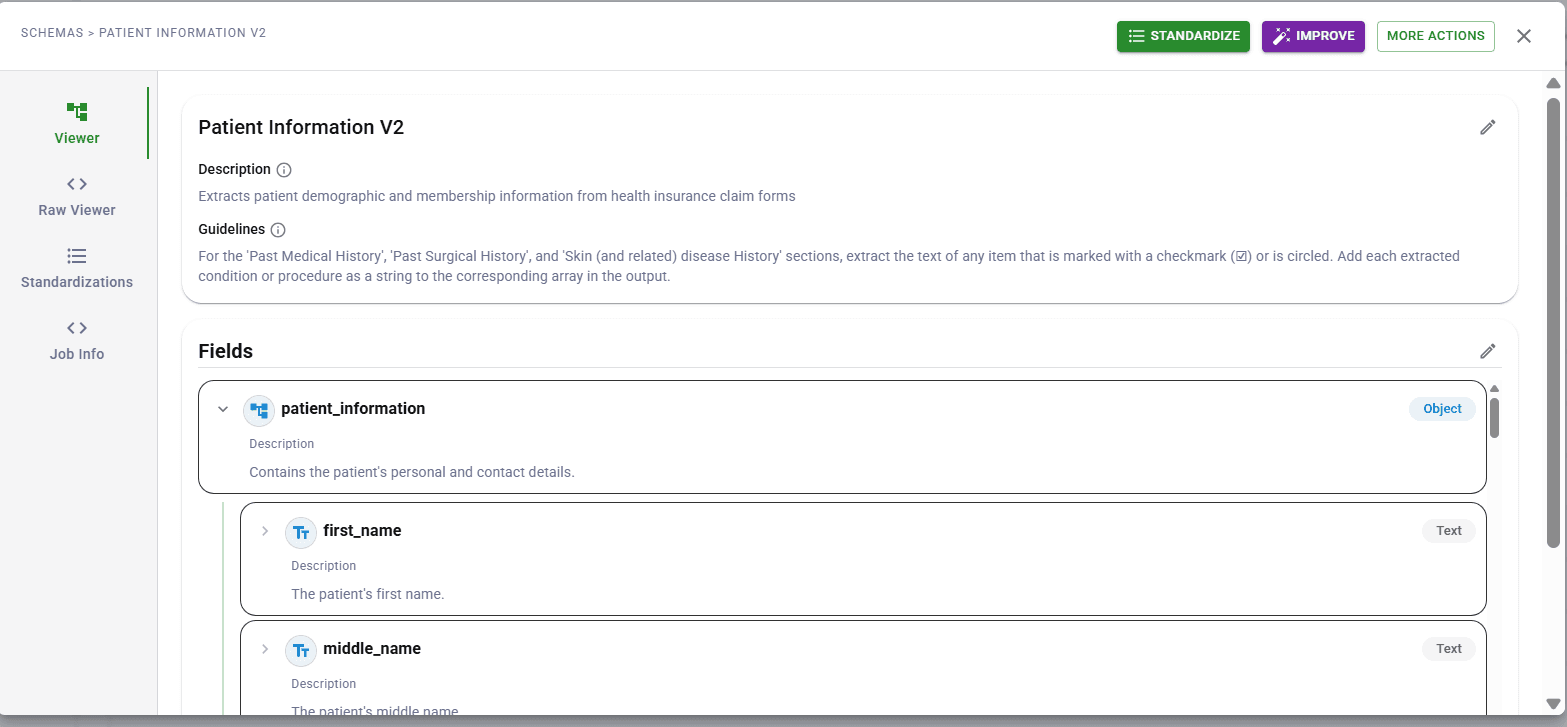
Reducto is purely code-driven. Your JSON schemas live in your codebase. When your ops team needs to add a new field to extract - say, a new compliance requirement - they file a Jira ticket. A developer updates the schema payload. Code review. Deploy. Done in a week if you're lucky.
DocuPipe has a dedicated schema dashboard. Upload a sample document and AI suggests fields automatically. Your ops team can add, remove, or modify fields without touching code. Changes take effect immediately. No deploy required.
For engineering teams that insist on owning all orchestration in code (and have the bandwidth to build it), Reducto provides that level of control. But for teams where ops and engineering need to collaborate on extraction logic, DocuPipe's dashboard removes the bottleneck.
Source traceability: DocuPipe's source highlighting vs coordinates
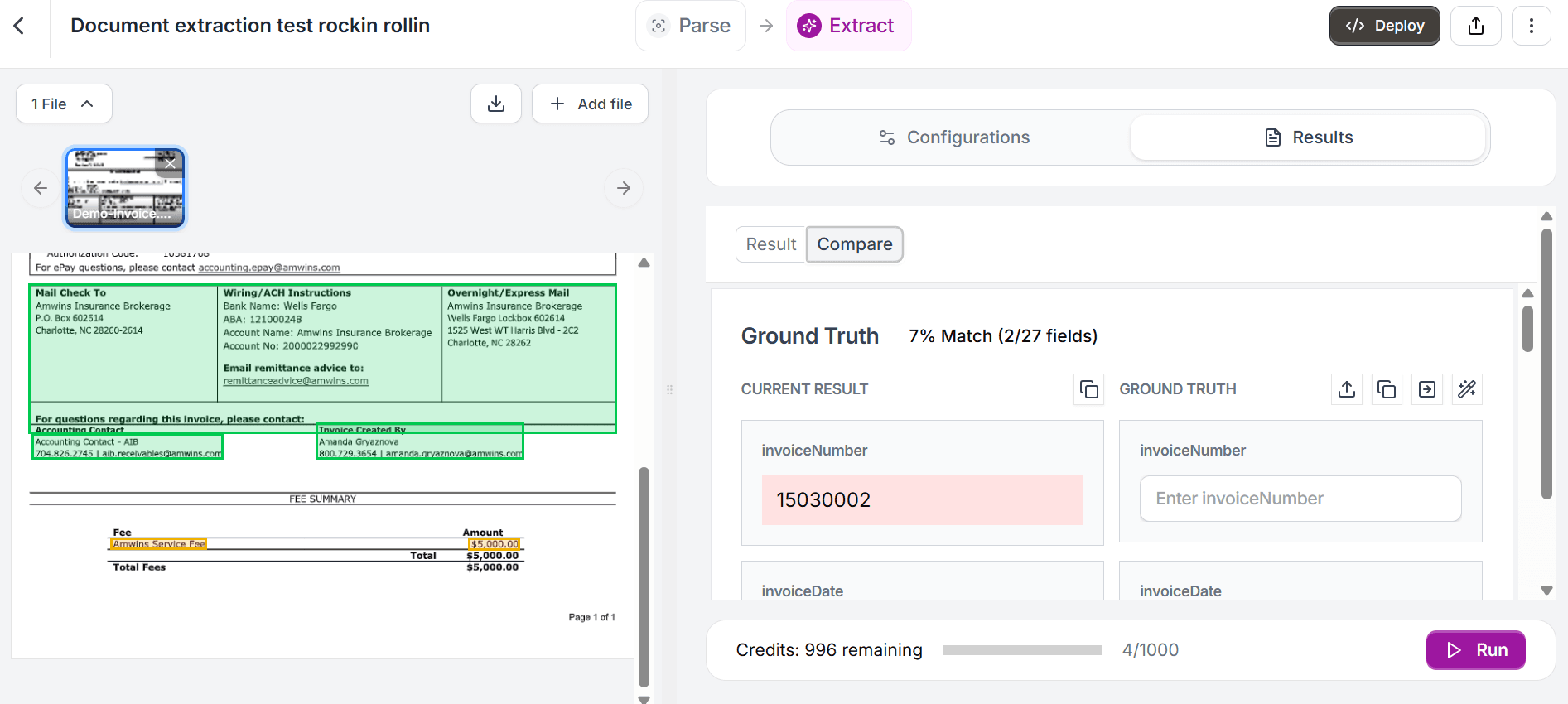
Both DocuPipe and Reducto tell you where extracted data came from. Reducto provides bounding box coordinates - pixel positions you can use to build your own highlighting.
DocuPipe takes this further with built-in visual review. Click any extracted field in our dashboard and see it highlighted on the original document - we call it the source highlighting. No code required. Your ops team can verify extractions immediately, seeing exactly what the AI saw.
For compliance-heavy industries like healthcare and finance, this audit trail is non-negotiable. DocuPipe's built-in traceability means you're not building verification infrastructure from scratch.

Built for engineers vs built for teams
Reducto is infrastructure built by engineers, for engineers. Schemas live in code. Changes require deploys. There's no dashboard where your ops team can adjust extraction fields without filing a Jira ticket. That's a deliberate design choice - it gives engineering teams full control.
DocuPipe is built for teams where ops and engineering collaborate. Our schema dashboard lets non-technical users upload a sample document, see AI-suggested fields, and modify extraction logic without touching code. Changes take effect immediately. Your ops team handles day-to-day schema updates; your engineers focus on integration.
If your extraction logic never changes, or you have dedicated engineers maintaining document pipelines, Reducto's code-only approach works. If your ops team needs to add fields when compliance requirements change - without waiting for a sprint cycle - DocuPipe removes that bottleneck.
See it in action
Up to 20,000 free credits with an eligible work email. No credit card required.
Human-in-the-loop: built-in vs build-your-own
Reducto is infrastructure - it gives you the building blocks and you assemble the application. Need human review? Build it. Need a verification queue? Build it. Need confidence thresholds that trigger manual inspection? Build it. Need business validation rules that catch extraction errors before they hit your database? Build that too.
DocuPipe ships with verification workflows built in. Low-confidence extractions get flagged. Your team reviews them in our UI with source highlighting. Corrections flow back. No additional infrastructure required.
For teams shipping fast, this is weeks of development you skip. For regulated industries, it's compliance infrastructure you don't have to maintain. Reducto gives you building blocks. DocuPipe gives you a complete solution.
When to choose Reducto vs DocuPipe
Choose Reducto if your engineering team wants to own the full orchestration layer, you prefer schemas in code over a dashboard, you don't need ops team access to extraction logic, and you're building the review UI yourself anyway.
Choose DocuPipe if your ops team needs to manage schemas without developer involvement, you need built-in human review with source highlighting, you want webhooks and classification out of the box, or you prefer a complete solution over assembling infrastructure.
Both are technically capable. The question is whether your team wants to build around extraction endpoints or use a pipeline that handles orchestration for you.
A note on third-party validation
One thing worth noting: as of March 2026, Reducto has minimal public reviews. Their accuracy claims are self-reported. DocuPipe has a 4.9/5 on G2 with verified customer reviews - including customers who report cutting 8-hour tasks to 23 minutes and processing handwritten forms at 98% reliability.
This isn't the main reason to choose one over the other - the operating model difference matters more. But if third-party validation is part of your evaluation criteria, it's a data point worth considering.
Which should you choose?
Choose DocuPipe if...
Your ops team needs to manage schemas without developer involvement
You want built-in human review with source highlighting
You prefer a complete solution over assembling extraction infrastructure
You need both technical and non-technical users working with the same system
You want webhooks and classification out of the box
Choose Reducto if...
Your engineering team wants to own the full orchestration layer
You prefer schemas defined in code over a dashboard
You don't need ops team access to extraction logic
You're building the human review UI yourself anyway
You prefer infrastructure you control over integrated solutions
Skip the setup headaches
Start extracting documents in minutes, not weeks.
Frequently asked questions
Both platforms extract structured JSON. The key difference is operating model. Reducto is code-only infrastructure for engineering teams who want full control - you orchestrate endpoints, build the review UI, manage schemas in code. DocuPipe is a complete pipeline for teams where ops and engineering collaborate - schema dashboard, built-in human review, webhooks out of the box.
Yes. Reducto's /extract endpoint accepts a JSON schema and returns structured data. They also support bounding box citations. The difference is everything around it: DocuPipe has a schema management dashboard, built-in classification and routing, human review UI, and Svix webhooks. With Reducto, you build those yourself.
Reducto's Standard plan is $350/mo for 15,000 pages. DocuPipe Business is $99/mo. Reducto's RAG-first architecture means you're paying for parsing overhead even when you only need extraction.
Choose Reducto if your engineering team wants full control over document pipelines in code, you prefer schemas defined in your codebase rather than a dashboard, and you're building custom review workflows anyway. DocuPipe is a complete solution built for teams where ops and engineering collaborate.
With DocuPipe, yes. Our dashboard lets ops teams upload sample documents, get AI-suggested fields, and modify schemas without touching code. With Reducto, schemas are defined in API payloads - any schema change requires a developer to update the codebase and deploy.
Yes. Your JSON schemas work the same way - define fields and types. The main change is switching from orchestrating Reducto's endpoints yourself to setting up a DocuPipe Workflow that handles orchestration for you. Most teams migrate in a day.
DocuPipe supports 100+ languages with automatic mixed-language detection - a document with English headers and Spanish content is handled without special configuration. Reducto supports 100+ languages but doesn't auto-detect mixed-language documents.



The best way to compare? Try it yourself.
Up to 20,000 free credits with an eligible work email. No credit card required.