
8 min read
DocuPipe vs Mindee: Which is best for your team? [2026]

Published February 23, 2026
Looking for the best Mindee alternative? DocuPipe vs Mindee comes down to this: Mindee is actually two different products. Their pre-built APIs for receipts, passports, and invoices work great. But the moment you need to extract a 12-page legal contract or any custom document? You're using docTI - a completely different workflow with different capabilities. DocuPipe gives you one unified pipeline that handles any document type the same way. Whether it's a receipt or a contract, you get the same developer experience: split, classify, extract, webhook. No workflow switching. No fragmented tooling.
TL;DR
Mindee fragments extraction across pre-built APIs and custom docTI workflows. DocuPipe is one unified pipeline for all document types with your custom schema.
Table of Contents
- DocuPipe vs Mindee at a glance
- Mindee alternative: DocuPipe is one pipeline, not two different products
- Split, classify, extract, webhook: one call does it all
- Schema dashboard: AI-suggested fields vs manual configuration
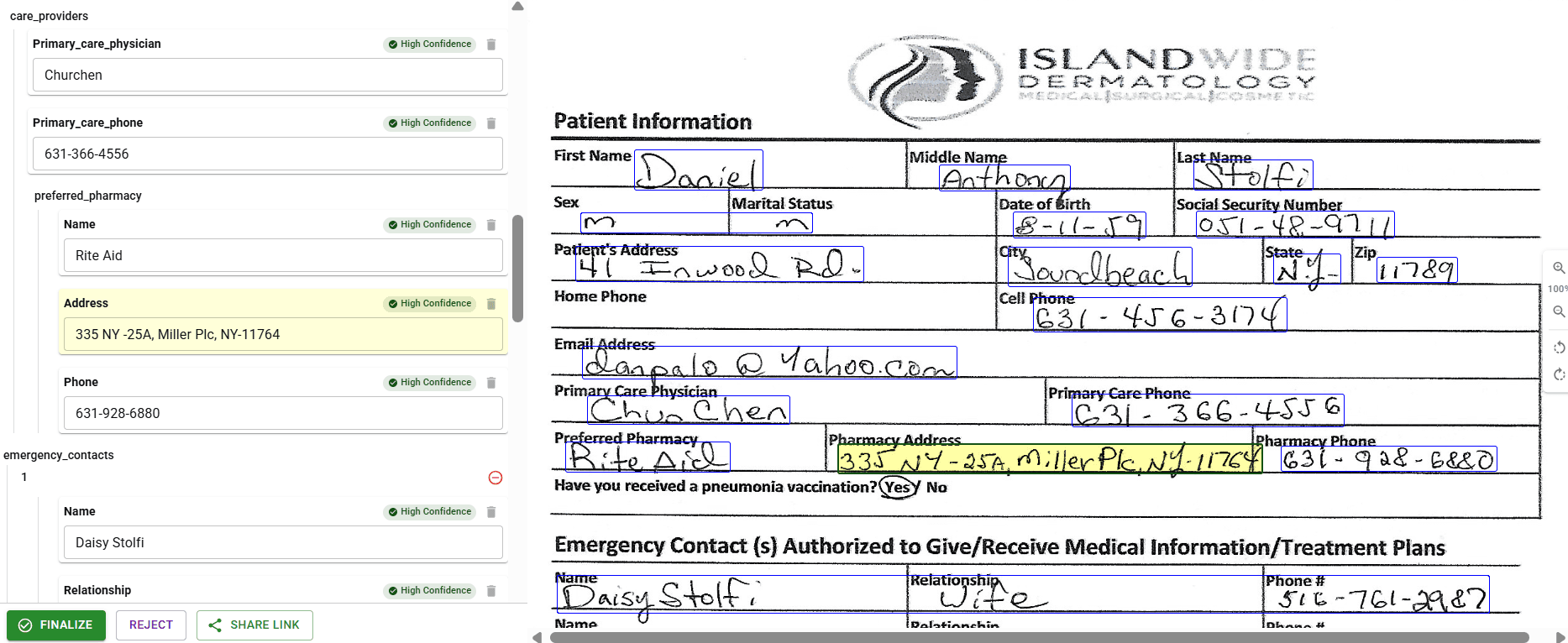
- source highlighting review: built-in verification vs build your own
- Custom documents: same workflow vs completely different system
- Developer experience: one system to learn vs two to maintain
- Which should you choose?
- FAQ
DocuPipe vs Mindee at a glance
| DocuPipe | Mindee | |
|---|---|---|
| Best for | Teams processing diverse document types | Teams with only standard docs (receipts, invoices) |
| Developer experience | One consistent API for everything | Two different systems depending on doc type |
| Custom documents | Same workflow as standard docs | Requires docTI (different workflow entirely) |
| Pipeline features | Split + classify + extract in one call | Classification and splitting are separate |
| Schema management | Visual dashboard with AI-suggested fields | Manual field configuration |
| Human review | Built-in source highlighting review UI | Build it yourself |
| Pre-built document types | Unified API handles all types | Receipts, passports, invoices only |
| Language support | 100+ languages | Varies by endpoint |
| Webhooks | Built into unified pipeline | Available (separate configuration) |
Ready to see the difference?
Get up to 20,000 free credits with an eligible work email. No credit card required.
Mindee alternative: DocuPipe is one pipeline, not two different products
Mindee provides basic OCR functionality that works for standard document types. Their pre-built APIs for receipts, passports, and invoices are fast to integrate. But here's the catch: Mindee lacks the advanced document understanding features needed for complex shipping workflows, legal contracts, or specialized industry documents. Their computer vision technology handles standard extractions well but cannot handle complex variations in formats or edge cases.
And their pre-built APIs lock you into their field definitions. Want a custom field? Too bad. Custom extraction for enterprise use cases is limited, forcing you into docTI - a completely different workflow with different capabilities.
DocuPipe takes a different approach. One unified document extraction API handles everything with advanced document understanding. Whether you're processing a receipt or a 50-page contract, the workflow is identical: define your schema, send the document, get structured data back. No locked field definitions. No switching between products.
Split, classify, extract, webhook: one call does it all
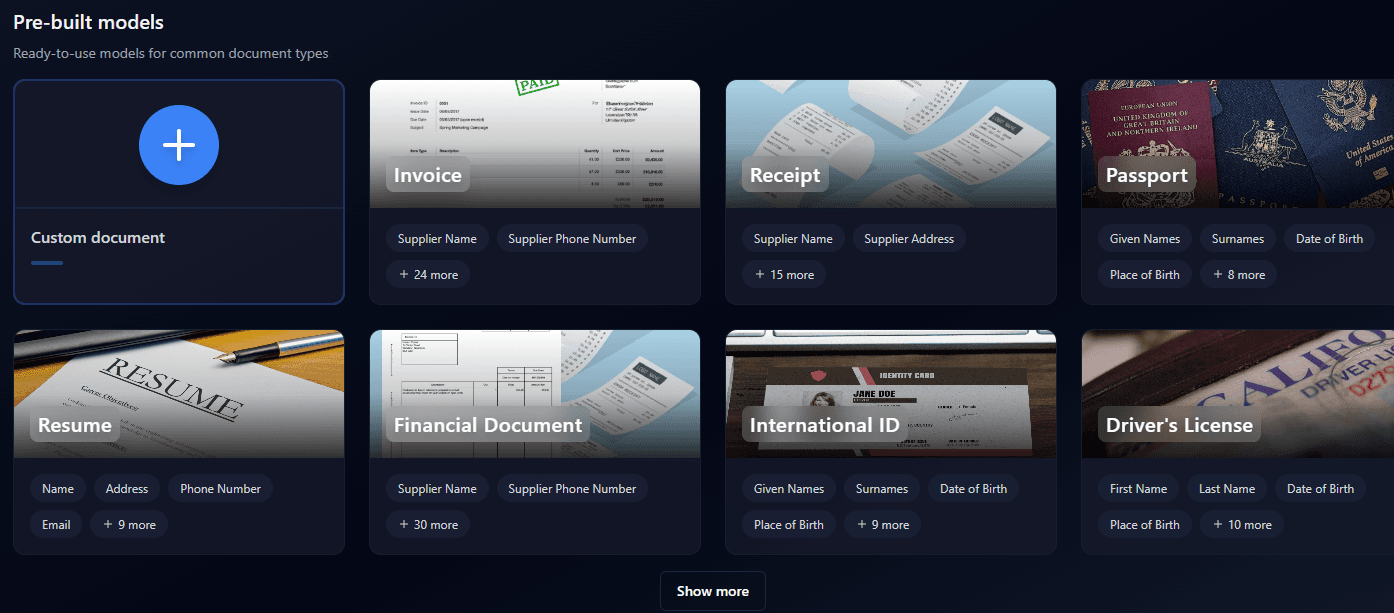
When comparing Mindee vs DocuPipe, the pipeline architecture tells the story. DocuPipe's intelligent document processing works in a single call. Upload a multi-document PDF, and DocuPipe automatically splits it into individual documents, classifies each one, extracts data according to the right schema, and fires your webhook. One API call. One integration to maintain.
With Mindee, these are separate steps you orchestrate yourself. Classification is a separate process. Splitting is manual or requires additional logic. You're building the glue code that connects these pieces. For simple use cases with one document type, this works fine. For production systems handling mixed document batches, it's more complexity to build and maintain.
DocuPipe's single-call pipeline is why teams processing diverse document types choose it as their Mindee alternative. And classification is remarkably cost-effective: at 0.1 credits per page, you can classify up to 25,000 pages on our $99/month Business tier. Less code to write. Fewer failure points. Faster time to production.
Schema dashboard: AI-suggested fields vs manual configuration
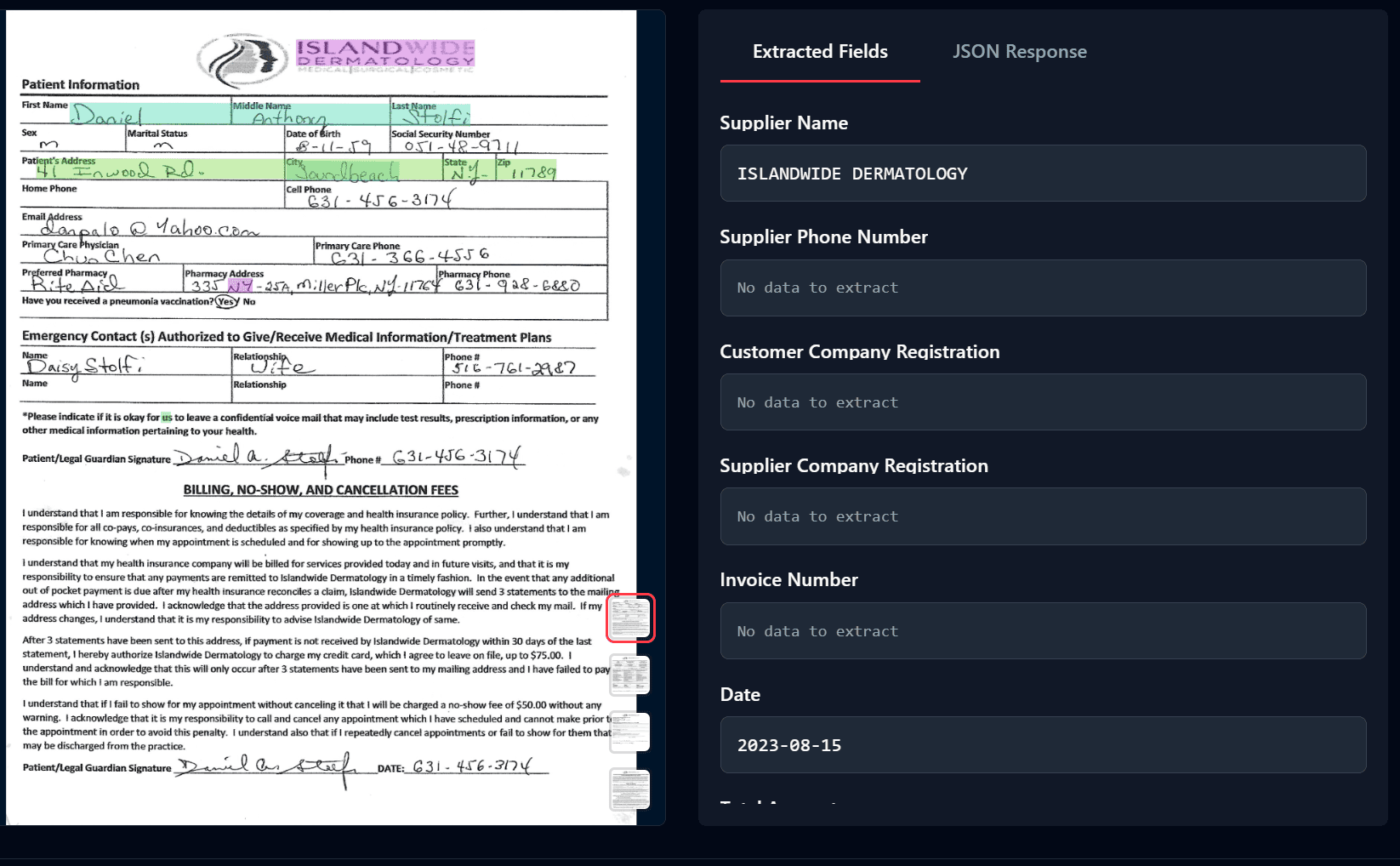
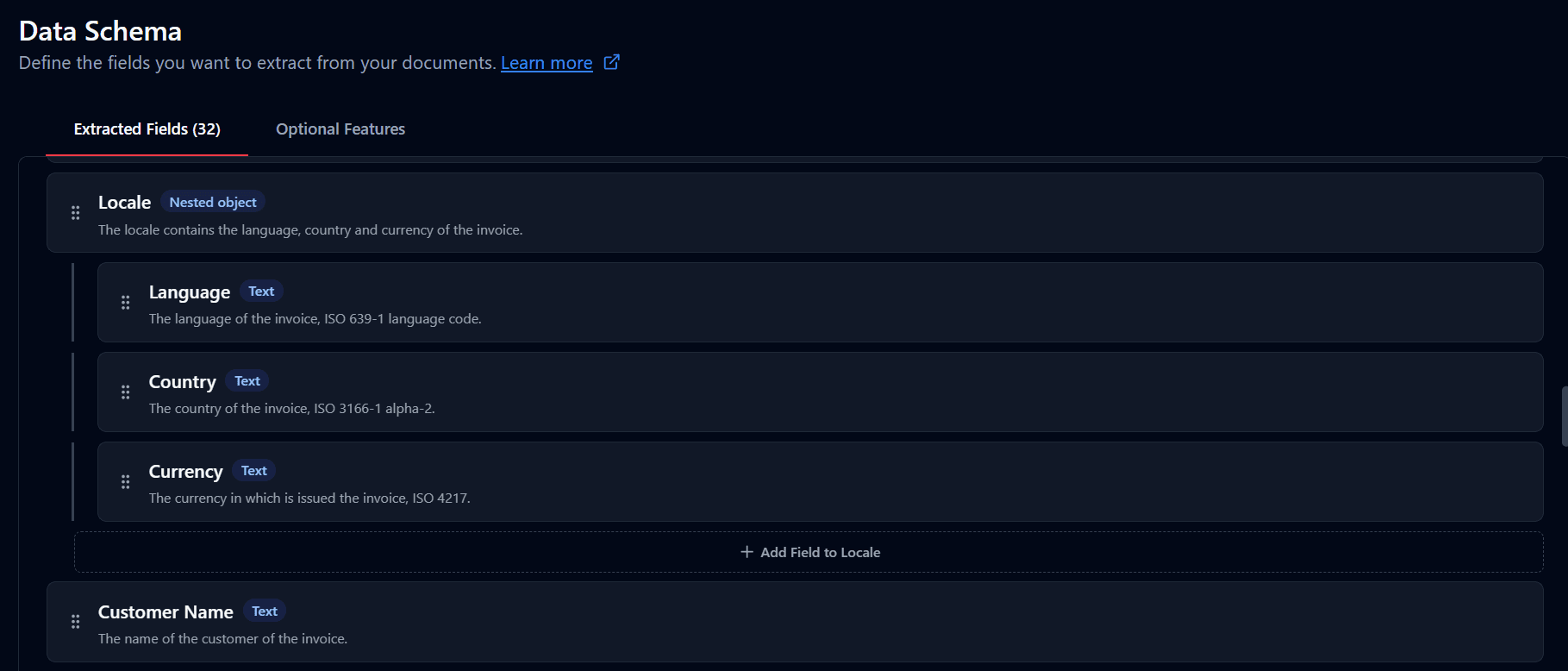
A key Mindee vs DocuPipe difference is how you define what to extract. DocuPipe's schema dashboard is ops-friendly. Upload a sample document, and AI suggests fields based on what it finds. Adjust names, add validation, preview extractions live. Your operations team can iterate on schemas without writing code.
Mindee's approach varies by product. Pre-built APIs have fixed schemas - great if they match your needs, limiting if they don't. DocTI requires more manual field configuration. There's no unified dashboard experience across both systems because they are, fundamentally, different systems.
For teams that need flexibility - custom fields, nested structures, document-specific logic - DocuPipe's visual schema builder with AI assistance makes iteration fast. You see what you're extracting before you ship to production.
source highlighting review: built-in verification vs build your own
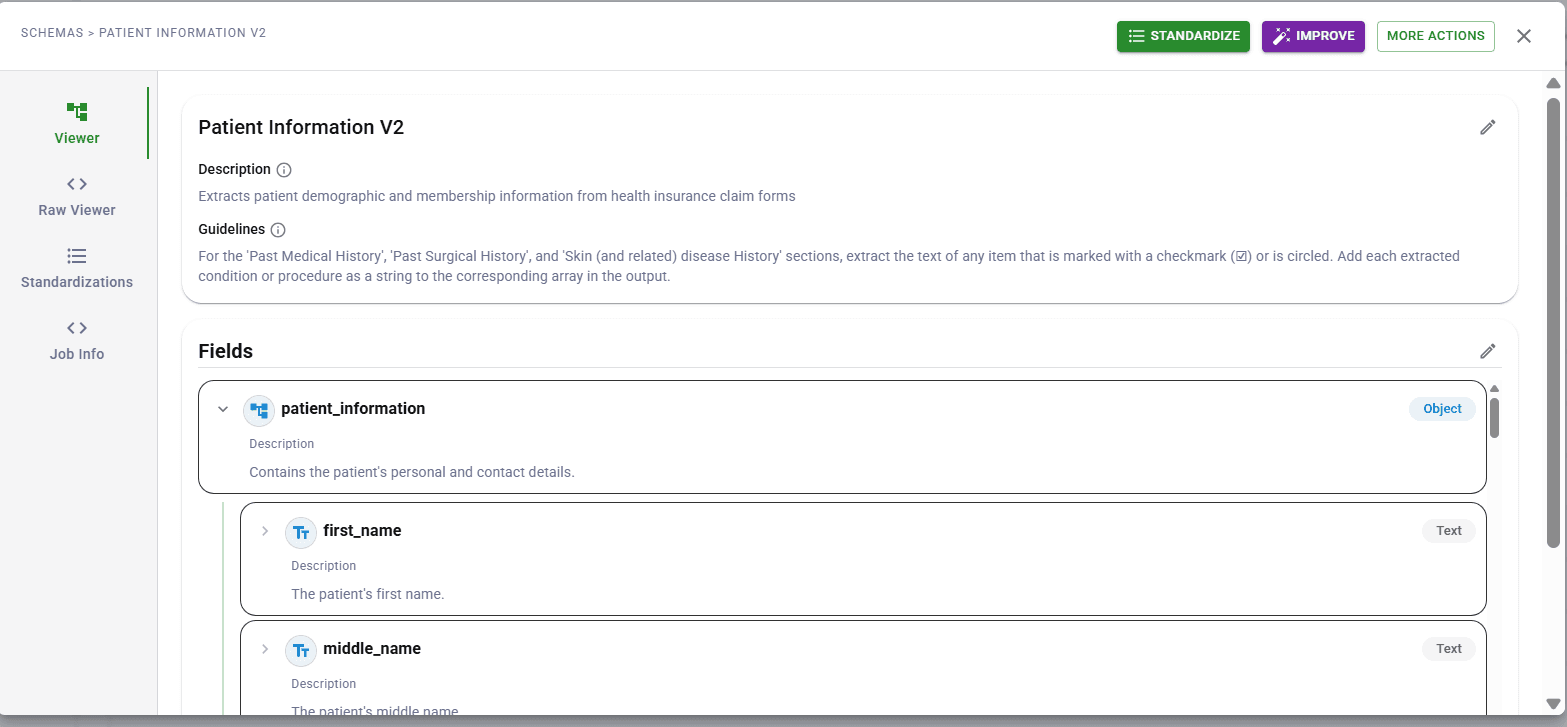
Human review is where Mindee alternatives often differ most. DocuPipe ships with source highlighting review UI built in. Click any extracted field and see exactly where it came from on the source document, highlighted in yellow. Confidence scores show which fields need attention. Your ops team can start reviewing documents immediately.
Mindee returns extracted data, but the review interface? That's on you to build. For teams with development resources to spare, this is doable. For teams that want to focus on their core product instead of building document verification tools, it's a significant extra investment.
For regulated industries - healthcare, finance, insurance - audit trails and human verification aren't optional. DocuPipe's built-in review handles this out of the box. That's weeks of development time you're not spending on infrastructure.
See it in action
Up to 20,000 free credits with an eligible work email. No credit card required.
Custom documents: same workflow vs completely different system
The most common reason teams look for Mindee alternatives is custom document support. Mindee's pre-built APIs handle standard documents - receipts, invoices, passports, bank statements. But what happens when you need to extract from a proprietary intake form, a custom contract template, or industry-specific documents?
With Mindee, you switch to docTI. Different workflow. Different capabilities. Different mental model. You're essentially learning a second product. DocuPipe handles custom documents the same way it handles everything else. Define a schema, send documents, get structured data. The workflow you learned for receipts works identically for 50-page legal contracts.
For teams whose document mix includes both standard and custom types, this consistency is why DocuPipe works as a Mindee alternative. One integration. One workflow. Any document.
Developer experience: one system to learn vs two to maintain
When evaluating Mindee vs DocuPipe, consider the long-term developer experience. With DocuPipe, there's one SDK, one set of endpoints, one documentation site, one mental model. Whether you're extracting from an invoice today or a medical form tomorrow, the code looks the same.
Mindee's fragmentation means maintaining two integration patterns. Pre-built API responses have one structure. DocTI responses have another. Error handling differs. Rate limits differ. When something breaks at 2 AM, your on-call engineer needs to know which system they're debugging.
For teams shipping product fast, this cognitive overhead adds up. DocuPipe's unified approach means less documentation to read, fewer edge cases to handle, and faster onboarding for new team members. That's the practical advantage of a single intelligent document processing platform over a collection of specialized tools.
Which should you choose?
Choose DocuPipe if...
You process both standard and custom document types
You want one unified workflow for all documents
You need automatic classification and splitting in the pipeline
You want built-in visual review with source highlighting
You prefer an ops-friendly schema dashboard with AI suggestions
You want consistent developer experience across all doc types
You need on-premise deployment for data residency
Choose Mindee if...
You only process standard docs (receipts, invoices, passports)
Mindee's pre-built API schemas match your needs exactly
You don't need custom document extraction
You're comfortable maintaining pre-built and docTI integrations
You have dev resources to build your own review interface
Skip the setup headaches
Start extracting documents in minutes, not weeks.
Frequently asked questions
Mindee offers two different products. Pre-built APIs handle specific document types (receipts, invoices, passports) with fixed schemas. DocTI is their solution for custom documents - it's a completely different workflow with different capabilities. DocuPipe offers one unified approach: the same pipeline handles any document type, whether standard or custom. This is why teams processing diverse documents often choose DocuPipe as their Mindee alternative.
If you only process standard document types that exactly match Mindee's pre-built API fields (receipts, invoices, passports) and will never need custom extraction or fields outside their predefined schema, Mindee works. But the moment you need a custom field or a document type they don't support, you're switching to their completely different docTI system. Most teams outgrow pre-built schemas fast.
Mindee has optimized specifically for receipts, invoices, and IDs - but only through their pre-built APIs. DocuPipe delivers high accuracy across any document type without switching workflows. The difference is consistency: DocuPipe maintains the same accuracy approach whether you're processing a receipt or a custom contract, while Mindee's accuracy varies between pre-built APIs and docTI.
Yes. DocuPipe extracts from receipts, invoices, and all standard document types with the same unified pipeline. The difference is you use the same workflow for receipts that you use for any other document. Define your schema (or use a template), send documents, get structured data. No separate endpoints or systems to maintain.
Yes, webhooks are built into DocuPipe's unified pipeline. When extraction completes, your webhook fires automatically - along with splitting and classification if you're processing multi-document batches. With Mindee, webhooks work differently across pre-built APIs and docTI. DocuPipe gives you one consistent webhook experience regardless of document type.
DocuPipe includes classification in the unified pipeline. Send a mixed batch of documents, and DocuPipe automatically classifies each one before extraction. With Mindee, classification is a separate process you orchestrate yourself. For teams processing diverse document types, DocuPipe's integrated classification reduces code and complexity.
Most teams complete Mindee to DocuPipe migration in a day or two. The concepts map directly: document types become schemas, API calls map to our unified endpoint. The main simplification is consolidating your pre-built API calls and any docTI integration into one consistent DocuPipe integration.
Yes. DocuPipe handles batch processing with automatic splitting - upload a multi-document PDF and it separates, classifies, and extracts from each document. Results come back structured with per-document data. The same unified pipeline handles single documents and batches.
Yes. DocuPipe is ISO 27001 compliant. We sign BAAs for healthcare customers. For organizations with strict data residency requirements, on-premise deployment keeps everything inside your infrastructure. The built-in source highlighting review interface provides audit trails for human verification.
DocuPipe is purpose-built for teams processing a mix of document types. One unified pipeline handles standard documents (receipts, invoices) and custom documents (contracts, forms, proprietary templates) with the same workflow. If you're tired of maintaining separate integrations for pre-built APIs and custom extraction, DocuPipe consolidates everything into one intelligent document processing platform.



The best way to compare? Try it yourself.
Up to 20,000 free credits with an eligible work email. No credit card required.